
By Alex Firdaus · Published August 8, 2026 · Sourced from the verified complaint and cross-checked against the federal docket, Case 1:26-cv-08846, N.D. Illinois
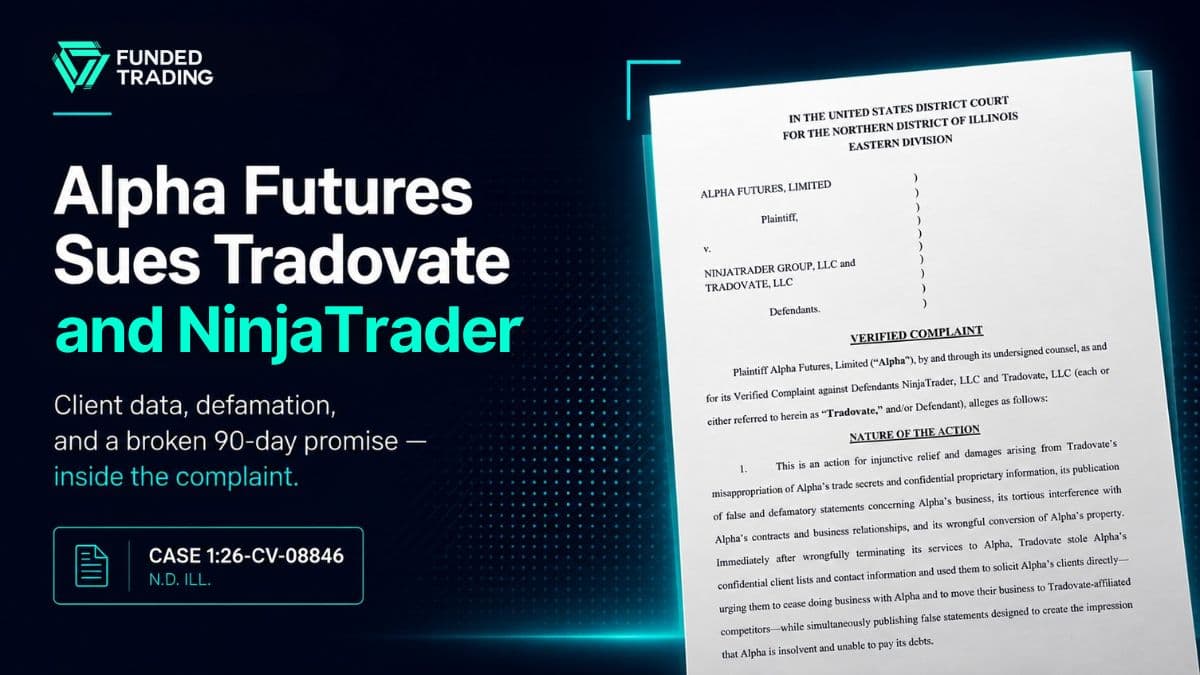
Alpha Futures Sues Tradovate and NinjaTrader Over Client Data, Defamation
The short version: Alpha Futures filed a federal lawsuit against NinjaTrader Group LLC and Tradovate, LLC on July 24, 2026, 12 days after the two sides publicly split. As of publication, this filing has not been reported elsewhere. FundedTrading is covering it directly from the court complaint. Alpha claims Tradovate promised an orderly 90-day wind-down, then cut off trading access within days, and used Alpha's client list to route traders toward Tradovate-affiliated competitors.
What happened
Alpha Futures Limited filed a verified complaint against NinjaTrader Group LLC and its subsidiary Tradovate, LLC in the U.S. District Court for the Northern District of Illinois on July 24, 2026. The case is 1:26-cv-08846. This filing does not appear to have been reported elsewhere as of this article's publication date. FundedTrading obtained the complaint directly and independently confirmed the filing against the federal docket via UniCourt's public case record, which lists the same case number, parties, and filing date. Alpha Futures is a company organized under the laws of England and Wales that ran its evaluation and funded accounts on Tradovate's platform under an Evaluation Services Agreement.
The case is assigned to Judge John Robert Blakey, with Magistrate Judge Heather K. McShain designated for pretrial matters. Alpha filed the complaint alongside a civil cover sheet and attorney appearances from Sandy L. Morris and Jennifer E. Novoselsky, paying the standard $405 federal filing fee. As of publication, the docket shows no response filed by Tradovate or NinjaTrader.
According to the complaint, Tradovate sent Alpha a letter on July 9, 2026 promising 90 days' notice of termination, an "orderly transition," and an initial suspension limited to new account sign-ups. Alpha says none of that happened. Over the weekend of July 10, Tradovate cut off all trading and access on its platform, which the complaint says rendered Alpha's customer accounts inoperable.
Tradovate's stated reason was a "prior balance" of $225,700. Alpha calls that figure a pretext. The complaint notes it equals just over 1% of everything Alpha has paid Tradovate since the relationship began, that Tradovate raised it for the first time in more than six months, and that a Tradovate representative, Daniel Hodgeman, had previously told Alpha the same amount would be credited against Tradovate's own billing errors rather than owed.
Alpha's complaint also alleges a second category of breach separate from the balance dispute. It claims Tradovate swapped the APIs underlying its platform with unreasonable frequency, on a near-monthly basis at points, forcing Alpha to repeatedly rebuild its own integration on short notice. Alpha says this is documented in an extensive record of two-way communications between the two companies, though none of that record is attached to the public complaint.
The complaint's sharpest allegation involves client data. Alpha says that immediately after cutting access, Tradovate used Alpha's client list and contact information to solicit those same traders by email and social media, encouraging them to move their business to Tradovate-affiliated competitors. Alpha also alleges Tradovate made public statements implying Alpha could not pay its debts, which Alpha calls false and defamatory.
The background nobody agrees on
Everything in this section comes from prior news coverage, not from the complaint itself, which does not describe the events below.
This lawsuit is the latest chapter of a story that started on July 12, 2026, when Alpha Futures first announced the split publicly on X. At the time, Alpha framed the termination as NinjaTrader's decision, tied to three months of failed negotiations over Alpha's own proprietary platform, AlphaTrader, and whether NinjaTrader would tolerate Alpha promoting a competing product on equal footing. Alpha closed its Premium Plan the same day, citing more than $25 million paid out on that plan in two months, and multiple industry directories delisted Alpha within 24 hours over payout concerns.
NinjaTrader's side of that story, reported at the time by Finance Magnates, centered on an unpaid balance dispute rather than the competing-platform framing Alpha had pushed publicly. That reporting also traced the $225,700 figure back further: Alpha says it settled a separate $2.4 million overcharge dispute with Tradovate in early 2026, and the $225,700 was believed at the time to be leftover credit from that settlement, not a new debt.
The new complaint mentions AlphaTrader exactly once, and only to reject Tradovate's public suggestion that Alpha migrated its clients to dodge a debt. It does not revisit the three-month negotiation over backend integration and platform promotion that drove the original public dispute in July. The lawsuit is built entirely around the termination process itself, the client list, and the statements Tradovate made afterward, not around the platform-competition story Alpha told on social media weeks earlier.
Is a client list actually a trade secret?
This is analysis, not a claim from the complaint itself. Count I rests on the Illinois Trade Secrets Act, and it treats Alpha's client list and contact information as a trade secret because the list has independent economic value and Alpha took reasonable steps to keep it confidential. That is the correct legal standard to plead, but pleading it and proving it are different things. Whether a customer list clears the bar as a trade secret typically comes down to the specific secrecy measures a plaintiff can document, not the assertion alone. This complaint does not spell out what those measures were, only that they existed.
Alpha's position may be stronger than a typical customer-list case because the list sat inside a platform Tradovate operated, not on Alpha's own servers. That shifts the question toward whether Tradovate had a contractual duty of confidentiality under the ESA, which the complaint argues directly, rather than whether Alpha's own security was adequate. That distinction is likely to be one of the first things a judge examines, probably at the TRO stage.
Why it matters for funded traders
Funded futures accounts run on infrastructure the prop firm does not own. Alpha Futures did not control Tradovate's servers, order routing, or account access, even though Alpha's traders were the ones with capital and payouts on the line. When that relationship ended, the accounts went dark over a weekend with no advance warning to the traders themselves.
This is the same risk the industry saw when ProjectX changed its prop firm partnerships earlier in 2026: the platform provider makes a business decision, and traders absorb the disruption regardless of which side of a contract dispute is right. A firm's Trustpilot score and payout history do not protect a trader from a platform-level shutdown the firm itself did not see coming.
The added twist in this case is the client list allegation. If a platform provider can access a departing firm's client data and use it to redirect that firm's own traders elsewhere, the provider is not just an infrastructure vendor anymore. It becomes a direct participant in where a trader's business ends up. Firms and traders evaluating prop trading platform and technology providers now have a concrete, filed example of what that risk can look like in practice.
What changes for funded traders right now
Nothing changes immediately for traders on other firms or other platforms. This is a contract and tort dispute between two companies, not a regulatory action, and it does not affect Tradovate's relationships with other prop firms that were not named in the complaint.
Alpha Futures traders whose accounts were affected by the July 12 termination should rely on Alpha's own communications and the firm's AlphaTrader migration, not this lawsuit, for account-specific answers. A civil complaint takes months to resolve even if a temporary restraining order is granted quickly, and none of the compensatory or punitive damages sought would flow to individual traders directly.
What to watch next
Alpha Futures is asking the court for a temporary restraining order and preliminary injunction blocking Tradovate from contacting Alpha's clients, using Alpha's client data, or making further public statements about Alpha's finances. A ruling on that request, expected well before the underlying case is resolved, will show how far a court is willing to go to limit a platform provider's post-termination conduct.
Watch for whether Tradovate and NinjaTrader file a response or a counterclaim. The docket shows no answer or motion from either defendant as of publication, and Tradovate's own version of the billing dispute has only appeared so far in social media statements and prior reporting, not in a sworn court filing. Whichever version the court credits will set the factual record the rest of the case runs on.
Alpha has also asked the court to order Tradovate to preserve all documents, electronically stored information, and tangible things relevant to the case. A preservation request that specific, filed alongside the complaint rather than after, points to a firm preparing for a real discovery fight over the two-way communications both sides keep referencing, not a case Alpha expects to settle quietly in a few weeks.
Comparing platform-dependency risk across prop firms
See how other futures prop firms structure their platform and technology relationships before you fund an account.
Compare Prop Firms