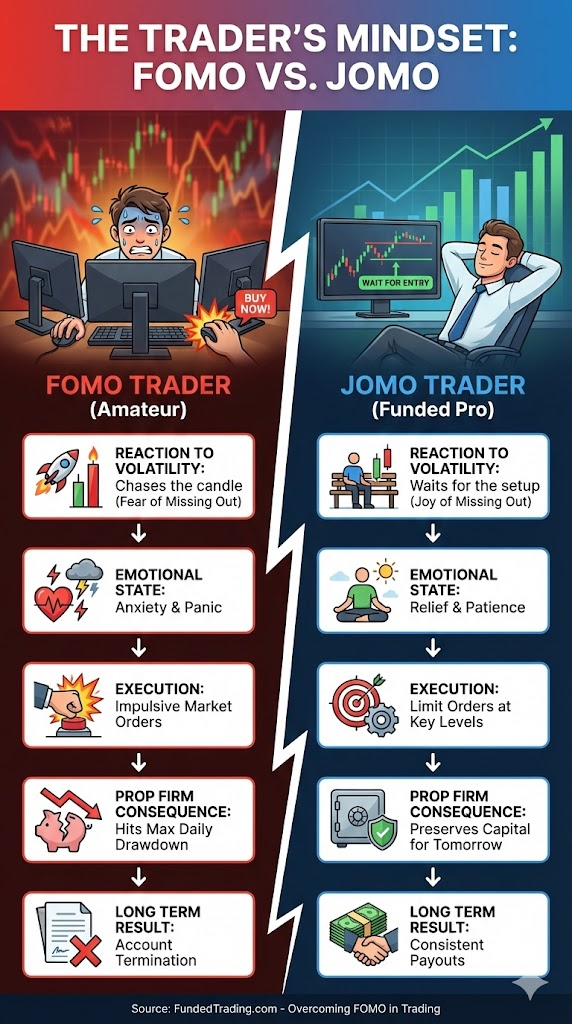
Most traders fail prop firm challenges because they cannot sit on their hands. The technical analysis might be perfect, but the execution fails under emotional pressure. In the proprietary trading ecosystem, capital preservation is the only metric that matters. When you chase a trade out of fear, you are not just risking a standard stop loss. You are risking your daily drawdown limit, your evaluation fee, and the opportunity cost of a funded account. The Fear of Missing Out (FOMO) is the specific psychological mechanism that causes competent traders to violate strict risk parameters and lose their funded status.
The Neuroscience of Missing Out: Why Traders Chase Candles
FOMO is often dismissed as simple greed, but it is actually a biological survival mechanism. When a market moves violently without you, your brain perceives a scarcity threat. This activates the amygdala. This part of the brain manages immediate threats and bypasses the prefrontal cortex, which is responsible for logic, planning, and risk management.
You literally cannot think straight during a FOMO episode because your brain chemistry has shifted to survival mode. This chemical override ignores your trading plan and forces you to click the buy button to alleviate the anxiety of “being left behind.” This impulsive loop often leads to a severe emotional crash after the loss is realized. This connects directly to the cycle of trading psychology and the 7 guilts that plague traders who cannot forgive themselves for emotional errors. Understanding that this is a biological “hijack” is the first step to regaining control.
Diagnosing the Symptoms: How FOMO Manifests in Market Behavior
You need to identify the specific behaviors FOMO creates before they destroy your equity curve. It typically manifests as entering a trade simply because the price is moving fast, often near the top of a green candle or the bottom of a red one. This implies you are reacting to price velocity rather than market structure.
This reaction often triggers the double loss in trading markets. A trader chases a move, gets stopped out, and immediately re-enters in the opposite direction out of anger and panic. This rapid accumulation of losses is a disaster for prop firm metrics like Max Daily Loss. These impulsive actions are consistently ranked among the top 14 extremely common beginner trading mistakes that prevent traders from ever securing a funded account. If your trading journal shows entries that do not align with your setup checklist, you are likely suffering from this specific psychological leak.
The Financial Impact on Funded Accounts
The cost of FOMO in a proprietary trading environment is far steeper than in a personal brokerage account. In a personal account, you can hold a losing trade hoping it comes back. In a funded account, that same behavior will hit your max trailing drawdown limit and terminate the account immediately. The strict rules of prop firms mean that a single moment of emotional weakness often results in a hard breach of the daily loss limit.
This is most dangerous during high-impact news releases. Traders see the volatility and fear missing a 100-pip move, so they enter with high leverage right as the spread widens. This is not trading. It is gambling. Learning how to trade the economic news in volatile markets requires waiting for the initial whip-saw to settle rather than chasing the first candle you see. The spread expansion and slippage during these moments can violate your risk rules instantly, proving that patience is a capital preservation tool.
Systematic Frameworks to Eliminate Emotional Bias
You cannot willpower your way out of biological impulses. You need a system that removes the need for willpower entirely. This starts with a rigid routine where no trade is taken unless it satisfies every condition of your edge. A professional trading plan serves as your contract with yourself. If the market conditions do not match the plan, there is no decision to make. You simply do nothing.
The most effective way to enforce this is through documentation. A trade taken out of FOMO looks embarrassing when you have to write it down. Using the best trading journal strategies allows you to audit your emotions. When you are forced to record that you entered a trade because “it was moving fast” rather than “it hit my support zone,” you expose the flaw in your process. This awareness breaks the cycle of impulse trading by making you accountable for every click.
Technical Solutions: Automating Discipline
If psychological frameworks fail, technology offers a hard stop to emotional errors. Many funded traders have moved away from manual execution entirely to avoid the temptation of the mouse click. They utilize algorithms that only execute when specific logic is met. Finding the top 3 prop firms for Expert Advisors (EA) trading allows you to deploy bots that do not feel fear or greed. These tools execute your strategy without the hesitation or impulsiveness that plagues human traders.
For those who do not code, another layer of separation is copy trading. You can link your master account to a slave account or follow a disciplined signal provider. Using the best trade copier for forex prop traders ensures that execution is handled mechanically. This creates a firewall between your emotions and the buy button. By outsourcing the execution, you remove the opportunity for FOMO to intervene in your financial results.
Comparative Analysis: FOMO vs. Disciplined “JOMO”
The antidote to the anxiety of missing out is cultivating the Joy of Missing Out (JOMO). This psychological shift reframes a missed trade opportunity as a victory for risk management rather than a loss of profit. A trader suffering from FOMO views every candle movement as money they should have made. This mindset leads to high-frequency trading, high stress, and a jagged equity curve that eventually hits a drawdown limit.
In contrast, a disciplined trader feels relief when they skip a setup that was sub-optimal. They understand that preserving their mental capital is just as important as preserving their account balance. This patience is the primary differentiator between gambling and a professional career. Traders often ask is forex trading profitable in the long run. The answer is yes, but only for those who derive satisfaction from following their rules rather than chasing market noise. The transition from FOMO to JOMO marks the maturity of a funded trader.
Conclusion: Mastering the Mind for Funded Success
Overcoming FOMO is the definitive hurdle for anyone seeking to manage capital professionally. It requires acknowledging that your biological instincts are often wrong for the financial markets. By implementing strict checklists, maintaining an honest trading journal, and potentially using automated tools to handle execution, you build a fortress around your emotions. This ensures that your funded account is protected from the one thing that destroys most careers: the impulsive need to be in the market at all times.
Once you have established this level of discipline, you are no longer a liability to a proprietary firm. You become an asset. You have proven that you can protect the downside, which is the primary requirement for managing large sums of money. With your psychology under control, you are positioned to take the next step and explore how to get instant funding for forex to leverage your patience into a scalable income. The market will always offer another trade, but it will not offer you another account if you lose this one to fear.