



By Alex Firdaus · Updated July 2026 · Data sourced from CFTC court filings, Quinn Emanuel case summary, FX News Group, Finance Magnates
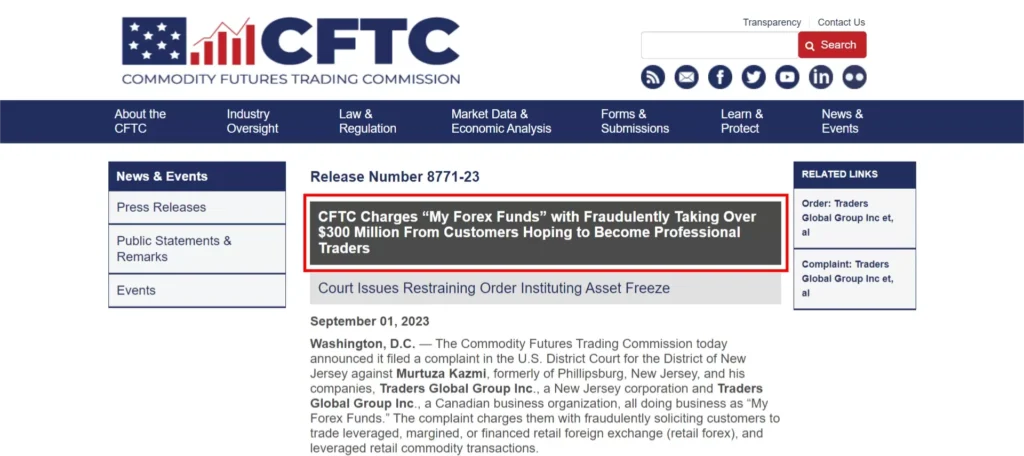
The CFTC froze My Forex Funds' assets overnight in August 2023, alleging a $310 million fraud scheme affecting 135,000 customers. The case fell apart. The central evidence used to justify the asset freeze — a CAD $31.5 million transfer — turned out to be a legitimate tax payment to the Canada Revenue Agency. The CFTC had documentation confirming this at least 11 days before it filed. A federal court dismissed the case with prejudice in May 2025, sanctioned the CFTC, and awarded attorney fees to MFF. In April 2026, MFF began sending payout emails to traders who had outstanding payments at the time of the shutdown.
Table of Contents
What Was My Forex Funds?
My Forex Funds (MFF) was a proprietary trading firm operating under the legal entity Traders Global Group Inc., registered in both New Jersey and Canada. Founder and CEO Murtuza Kazmi launched the firm around 2021. Within two years it had become one of the largest prop firms in the world by trader count, with over 135,000 customers and more than $310 million in collected fees.
The business model was standard for the retail prop sector: traders paid a fee to attempt an evaluation challenge. Those who passed received access to a simulated funded account and were entitled to a share of the profits they generated. MFF offered three program tiers (Rapid, Evaluation, and Experienced) across account sizes ranging from small retail entries to multi-thousand-dollar programs.
At its peak the firm was processing around 2,000 new customers daily. It employed over 300 staff globally. By summer 2023 it was one of the most-searched prop firms in the industry, with a large and active Reddit community and a strong reputation for paying out consistently. Then, on August 29, 2023, every account went dark.
The CFTC Complaint — August 2023
On August 28, 2023, the US Commodity Futures Trading Commission filed a complaint in the District Court of New Jersey against Murtuza Kazmi, Traders Global Group Inc. (New Jersey), and Traders Global Group Inc. (Canada), all operating as My Forex Funds. The complaint alleged a large-scale fraud scheme involving leveraged retail foreign exchange and retail commodity transactions.
The same day, the CFTC filed an ex parte motion — meaning MFF had no notice and no opportunity to respond before the order was granted. On August 29, Judge Robert B. Kugler signed a Statutory Restraining Order that froze all of MFF's assets, placed the company into receivership, required books and records to be submitted to the CFTC, and effectively shut down the business overnight.
Simultaneously, the Ontario Securities Commission issued a temporary cease trade order against Traders Global Group Inc. and Murtuza Kazmi, citing potential breaches including fraud, unregistered trading, and distributing securities without proper authorization.
What the CFTC Alleged
The CFTC's complaint covered several categories of alleged misconduct. Understanding these matters even after the dismissal, because they defined how the industry and press covered MFF for two years.
Fraudulent solicitation
The CFTC alleged MFF misled customers about the nature of the product. Marketing phrases like "your success is our business" implied the firm had a financial interest in traders succeeding. The CFTC argued this was false.
Counterparty conflict
MFF told customers their trades executed against independent third-party liquidity providers. The CFTC alleged that Traders Global Group itself acted as the direct counterparty on most transactions. In that structure, trader losses are firm revenue — a structural conflict of interest the CFTC said was concealed.
Software manipulation
The complaint alleged MFF deliberately built artificial trade delays into its platform, causing trades to execute at worse prices than the trader saw when they clicked. It also alleged programmed slippage that consistently disadvantaged traders at execution.
Account terminations
The CFTC alleged MFF terminated profitable trader accounts under manufactured pretexts, allowing the firm to keep earnings it would otherwise owe as payouts. Hidden commissions that reduced trader profits were also cited.
Personal enrichment
The CFTC alleged Kazmi used proceeds to purchase luxury homes and automobiles and transferred tens of millions of dollars into personal accounts — framing the operation as designed to enrich its founder at the expense of customers.
The CAD $31.5 Million Problem
The CFTC's ex parte application to freeze MFF's assets depended on showing the court that Kazmi was dissipating funds — moving money out of corporate accounts and into personal accounts abroad. The central evidence for this was a CAD $31.5 million transfer the CFTC described in its sworn declaration as going to "an unidentified Kazmi account."
That description was wrong. The CAD $31.5 million was actually two pre-authorized payments to the Canada Revenue Agency: CAD $4.5 million and CAD $27 million. The bank records used codes "TXINS" and "TXBAL," which are standard Canadian bank codes for tax installments and tax balance payments. A basic review of those codes would have identified them as government tax payments.
What makes this critical is the timeline of what the CFTC knew and when.
| Date | What happened |
|---|---|
| June 16, 2023 | A CFTC attorney received an email placing him "on notice of at least the possibility" the transfers were tax payments |
| August 17, 2023 | The CFTC attorney and investigator received an email confirming the payments were corporate taxes owed to the Canadian government — 11 days before filing |
| August 28, 2023 | The CFTC filed its declaration describing the CAD $31.5M as a transfer to "an unidentified Kazmi account" — the asset freeze was granted based in part on this |
| September 19, 2023 | MFF filed an Emergency Motion to Modify the SRO. The CFTC's opposition brief again cited the CAD $31.5M transfers as going to "an account in Kazmi's name" |
| December 2023 | CFTC disclosed the August 17 email in a footnote of a brief — four months after it knew |
| March 7, 2024 | CFTC filed a "Corrected Declaration" acknowledging the CAD $31.5M was a tax payment |
The Special Master's Report, released in May 2025, found that the CFTC "relied on what it already knew by then was an erroneous statement" when it cited the transfers again in September 2023. The lead attorney later admitted during evidentiary hearings that he had been "careless and sloppy" in the investigation.
MFF's Defense
MFF retained Quinn Emanuel Urquhart and Sullivan alongside co-counsel King and Spalding. Both firms are among the largest litigation practices in the US. The defense built its case on three main arguments.
The business model was lawful
MFF argued that customers never invested their own funds. All account capital came from the company. Customers were independent contractors performing trading services on simulated accounts. The CFTC's jurisdiction over retail forex and commodity transactions did not apply to simulated trading environments where no real money changed hands at the execution level.
The asset freeze was built on false evidence
This became the case's central issue. Once the defense exposed that the CAD $31.5 million was a CRA tax payment, the foundation of the ex parte application collapsed. The defense filed a Motion for Sanctions arguing that the CFTC had manufactured a false justification for the freeze and then refused to correct it when the error became undeniable.
The CFTC's conduct destroyed a legitimate business
MFF's legal team framed the harm in concrete terms: the overnight shutdown of a business that had taken years to build, leaving Kazmi's family without financial support for months, and leaving tens of thousands of traders locked out of their accounts with no warning and no recourse. Their sanctions motion argued the freeze was not a good-faith enforcement error but a deliberate abuse of the ex parte process.
The Case Unravels: 2024 Hearings
In November 2023 the court partially unfroze MFF's assets, ordering the return of approximately $100 million to Kazmi while keeping $12.08 million frozen. The temporary receiver was discharged. This was an early signal that the CFTC's original evidence had not held up to scrutiny.
Evidentiary hearings before Special Master Jose L. Linares ran on September 19 and 20, 2024. During those hearings, CFTC staff were required to testify under oath. Lead attorney Ashley Burden admitted on the record that he had been "careless and sloppy" during the investigation. The CFTC's position was that the errors were "limited and inadvertent" and did not materially affect the case.
Closing arguments were held December 18, 2024. By January 2025 the Special Master had the full record and was preparing his recommendation.
Dismissal With Prejudice: May 2025
On May 13, 2025, Special Master Linares released his Report and Recommendation. It called for the CFTC's complaint to be dismissed with prejudice and for the CFTC to pay MFF's attorney fees. The Special Master found that the CFTC had acted "willfully and in bad faith on several occasions." His conclusion was direct:
"The CFTC, by virtue of its standing as a law enforcement arm of the United States government, is held to the highest standards, in particular when making an ex parte application to the Court. In multiple instances, with full knowledge of the error in a sworn declaration submitted to the Court, rather than be upfront, direct, and transparent, the CFTC took deliberate steps down a path of obfuscation and avoidance."
Judge Edward Kiel adopted the Special Master's recommendation. The case was dismissed with prejudice — meaning the CFTC cannot refile — and attorney fees were awarded. The court found the CFTC had used a "false, secret submission" to freeze the defendants' assets and had then compounded the misconduct by failing to correct it for months.
Quinn Emanuel and King and Spalding issued a joint statement describing it as "a rare rebuke of a federal law enforcement agency." The dismissal with prejudice is one of the most severe sanctions ever imposed against the CFTC in an enforcement action.
The Ontario Securities Commission
The OSC ran parallel proceedings against Traders Global Group Inc. and Kazmi in Ontario. The US and Canadian regulators shared evidence under the IOSCO Multilateral Memorandum of Understanding — meaning the CFTC's flawed declaration was sent to the OSC before the errors were corrected.
The Canadian receivership moved on a different timeline from the US case. After the US dismissal, the Ontario court scaled back the receivership substantially. A final court order in December 2025 directed the return of MFF's Canadian assets. As of mid-2026 the receivership unwinding process is still being completed, but the bulk of Canadian-held assets have been ordered back to the company.
Kazmi confirmed in his October 2025 public statement that the Canadian process was "still ongoing" at that point but described it as significantly reduced from its peak scope.
What Happened to Traders' Money
This is the question most people searching this page actually want answered. The short version is: pending payouts were frozen for nearly three years, but as of April 2026 the repayment process has started.
| Trader category | Status as of July 2026 |
|---|---|
| Pending payouts at shutdown (Aug 2023) | Repayment emails sent April 2026. Once MFF collects payment details via survey, payouts are expected to go out. Timeline not confirmed. |
| Open funded accounts | Frozen since shutdown. Account access and data recovery is described by MFF as "actively in progress." No confirmed restoration date. |
| Challenge fees paid before shutdown | No refund process announced. Challenge fees in the prop model are generally consumed by operations and not held in reserve for refund. |
| Traders who had no pending activity | No payment owed. These traders lost access to accounts but had no outstanding balance. |
MFF confirmed in April 2026 that emails were sent to traders who had a requested payout at the time of closure. For anyone who did not receive an email, the firm indicated it would post a survey to capture missing contacts. Payments were described as starting "promptly" after details are received, but no specific dates were given.
As of July 2026, MFF has not announced a relaunch date or committed to resuming operations. Kazmi has indicated the team is reassembling and analyzing data, but the business is not yet operational.
Full Timeline
- 2021 MFF launches. Traders Global Group Inc. begins offering prop firm challenge accounts under the My Forex Funds brand. Rapid growth follows.
- Jun 2023 CFTC attorney notified. An email places CFTC counsel on notice that the CAD $31.5M transfers may be tax payments. No correction made to the investigation.
- Aug 17, 2023 CFTC confirms transfers are CRA taxes. Attorney and investigator receive email confirming the CAD $31.5M were corporate tax payments to the Canadian government. Filing proceeds 11 days later with the original, incorrect characterization.
- Aug 28-29, 2023 CFTC files complaint and ex parte SRO. Judge Kugler grants the Statutory Restraining Order. All MFF assets frozen. Business placed into receivership. Accounts shut down overnight. OSC issues parallel cease trade order in Canada.
- Sep 2023 MFF files Emergency Motion to Modify SRO. CFTC's opposition again cites the CAD $31.5M as a personal Kazmi transfer — after the regulator already knew this was wrong.
- Nov 2023 Court partially unfreezes assets. Approximately $100 million in Kazmi assets ordered released. $12.08 million remains frozen. Receiver discharged.
- Dec 2023 CFTC discloses August 17 email. In a footnote in a December 1 brief — four months after the filing — the CFTC attaches the email confirming the transfers were tax payments.
- Mar 2024 CFTC files Corrected Declaration. Formally acknowledges the CAD $31.5M was a CRA tax payment. CFTC replaces its trial team.
- Sep 2024 Evidentiary hearings before Special Master Linares. CFTC staff testify. Lead attorney Ashley Burden admits on record he was "careless and sloppy." Two days of hearings, September 19-20.
- Dec 2024 Closing arguments. Both sides present final submissions to Special Master Linares on December 18.
- May 2025 Special Master recommends dismissal with prejudice. Report released May 13. Finds CFTC acted "willfully and in bad faith." Recommends case dismissal, CFTC sanctions, and attorney fee award. Judge Edward Kiel adopts the recommendation.
- Oct 2025 Kazmi breaks silence. First public statement since the 2023 shutdown. Confirms US case dismissed, describes it as "complete vindication." Notes Canadian receivership still being unwound.
- Dec 2025 Canadian court orders asset return. Ontario court issues final order for return of Canadian-held assets. Receivership unwinding in progress.
- Apr 2026 Trader repayment begins. MFF sends emails to traders who had pending payouts at the time of the August 2023 shutdown. Survey to follow for anyone who did not receive contact. Payments expected once details are collected.
- Jul 2026 Current status. Repayment process ongoing. Canadian receivership unwinding. MFF data access and account review in progress. No confirmed relaunch date.
What This Case Tells Us
The MFF case is unlike every other prop firm shutdown in recent history. True Forex Funds collapsed because its infrastructure failed. FTMO scaled back US access because of platform compliance pressure. MFF was shut down by a regulator that, on the court's finding, misrepresented evidence to obtain a freeze order and then concealed the error for months.
That does not clear the underlying questions about MFF's business model. The CFTC's factual allegations about counterparty conflicts, software delays, and account terminations were never tried. The dismissal was on procedural grounds, not an exoneration of every practice the CFTC described. Kazmi disputes all of it. The question of whether MFF's operations were genuinely fair to traders is separate from whether the CFTC handled the enforcement lawfully.
What the dismissal means for the industry
Prop firms now have a documented precedent: regulators who use ex parte asset freezes to shut down businesses are accountable for the accuracy of their filings. The CFTC's handling of MFF resulted in the most significant sanctions the regulator has faced in an enforcement action in years. That is a meaningful deterrent, at least in theory.
It also means the core jurisdictional question — does the CFTC have authority over simulated prop firm accounts where no customer funds are actually deposited or traded in real markets — remains unsettled. The MFF case was dismissed before that question was answered. The next enforcement action against a simulated-account prop firm will pick up where this one left off.
For traders evaluating firms now
The practical checklist from MFF is narrower than the TFF case. MFF's failure was not about platform dependency or broker relationships. It was about regulatory exposure. The questions worth asking before joining any prop firm operating in or serving customers from the US:
| Question | What MFF's case shows |
|---|---|
| Is the firm on any regulatory warning list? | MFF was not on the CFTC RED List before the action. Regulatory risk can appear without prior warning flags. |
| Where is the firm incorporated and which regulators have jurisdiction? | Dual US-Canada incorporation meant two separate proceedings. Cross-border exposure multiplies operational risk when a regulator acts. |
| Does the firm have financial reserves to survive an operational disruption? | MFF had $137M in paid-out profits before shutdown, so the firm was paying traders. But an overnight freeze with no revenue still left thousands of pending payouts unpaid for years. |
| What is the firm's counterparty structure? | The CFTC's counterparty allegation — that MFF acted as the direct counterparty to trades — is the structural question every simulated prop firm faces. Understand it before you sign up. |
FAQ
What happened to My Forex Funds?
The CFTC obtained an ex parte asset freeze against MFF and its founder Murtuza Kazmi in August 2023, alleging a $310 million fraud scheme. The key evidence used to justify the freeze — a CAD $31.5 million transfer — turned out to be a legitimate tax payment to the Canada Revenue Agency. The CFTC had documentation confirming this before it filed. The US case was dismissed with prejudice in May 2025 after the court found the CFTC acted willfully and in bad faith. MFF began repaying traders with pending payouts in April 2026.
Was My Forex Funds actually a fraud?
The CFTC's fraud allegations were never tried on the merits. The case was dismissed on procedural grounds because the CFTC misrepresented evidence and concealed the error. Kazmi and MFF have consistently denied all allegations. The dismissal is not a ruling on whether the underlying business practices were fair — it is a ruling that the CFTC's conduct in bringing the case did not meet the standards required of a federal law enforcement agency.
Will traders get their money back from My Forex Funds?
Traders who had pending payouts at the time of the August 2023 shutdown started receiving emails from MFF in April 2026 asking for payment details. MFF said payments would follow once details are collected. There is no announced process for refunding challenge fees paid before shutdown.
Is My Forex Funds coming back?
As of July 2026, MFF has not announced a relaunch date. Kazmi has indicated the team is reassembling and working through data recovery. The firm appears to be moving toward resuming operations but has not committed to a timeline.
Why was the CFTC sanctioned?
Special Master Jose L. Linares found the CFTC misrepresented the CAD $31.5 million tax payment as a personal Kazmi transfer in its sworn declaration, continued to cite the incorrect information even after internal emails confirmed the error, and failed to disclose or correct that error for months. The court concluded this was willful and in bad faith, not a simple mistake.
What does "dismissed with prejudice" mean?
It means the case is permanently closed and the CFTC cannot refile the same claims. A dismissal without prejudice would allow the government to bring the case again after correcting procedural issues. Dismissal with prejudice is the more severe outcome — it ends the litigation for good.
What is the difference between the MFF and TFF cases?
True Forex Funds shut down in May 2024 because its MetaTrader licenses were terminated and it could not survive three months of lost revenue while rebuilding on an alternative platform. That was an infrastructure and business-model failure. MFF's shutdown was caused by a government enforcement action that a federal court later found relied on misrepresented evidence. Structurally and legally they are very different situations.
Find Prop Firms With Verified Track Records
FundedTrading reviews 160+ prop firms across platform setup, payout history, rules, and regulatory standing so you can make an informed decision before paying a challenge fee.
See All Prop Firm Reviews