




Indonesia is moving from “interesting” to strategically important for prop trading. The mix of young investors, rising retail participation, strong mobile adoption, and visible attention from global trading platforms is starting to look too big to ignore.
That does not mean Indonesia is already a mature prop trading market. It means the conditions that usually come before a major growth phase are now visible in the data.
Quick Facts
- As of March 2026, 54.71% of Indonesia’s individual capital market investors were aged 30 or younger (KSEI).
- As of March 2026, Indonesia had 24.74 million capital market investors according to KSEI statistics.
- Indonesia had 230 million internet users at the end of 2025, equal to 80.5% internet penetration (DataReportal, published November 2025).
- On December 7, 2025, Robinhood announced agreements to acquire an Indonesian brokerage and a licensed digital asset trader to enter the local market.
Why does Indonesia matter for prop trading now?
Indonesia matters now because the demand-side signals and infrastructure-side signals are starting to line up at the same time. That is usually when a retail trading market stops looking speculative and starts looking strategically investable.
For years, Indonesia sat in the “large population, future potential” bucket. That is not enough on its own. Plenty of large markets never convert into strong trading markets because the audience is too old, the digital layer is too weak, or the local infrastructure never catches up.
Indonesia now looks different.
The audience is young. Retail investing participation is rising. Internet penetration is high enough to support mobile-first trading behavior. Global firms are making visible moves. And search results already show that prop firms are localizing for Indonesian traders instead of treating the market as a generic Southeast Asia add-on.
That combination matters more than any single headline stat.
What do the latest investor numbers say about Indonesia?
The latest investor numbers show that Indonesia is not just curious about markets. It is participating in them at scale, and the age profile is exactly the kind of skew that tends to matter for funded trading demand.
KSEI’s March 2026 statistics show 24.74 million capital market investors in Indonesia, with 54.71% of individual investors aged 30 or younger. That is not a minor demographic detail. It is one of the clearest reasons the market deserves attention.
You do not build a strong prop trading market from retirees first. You usually build it from younger, digitally native participants who are comfortable with:
- mobile-first platforms
- online education
- account onboarding
- fast experimentation across asset classes
OJK was already signaling the same direction earlier. In its August 29, 2025 press release, the regulator said Indonesia had 17.6 million capital market investors, with 54% under 30 at that time. The exact investor total has grown since then, but the age skew has stayed consistent.
That is the real signal. The market is getting larger, and it is still being led by younger participants.
[caption id="attachment_989899" align="alignnone" width="1614"]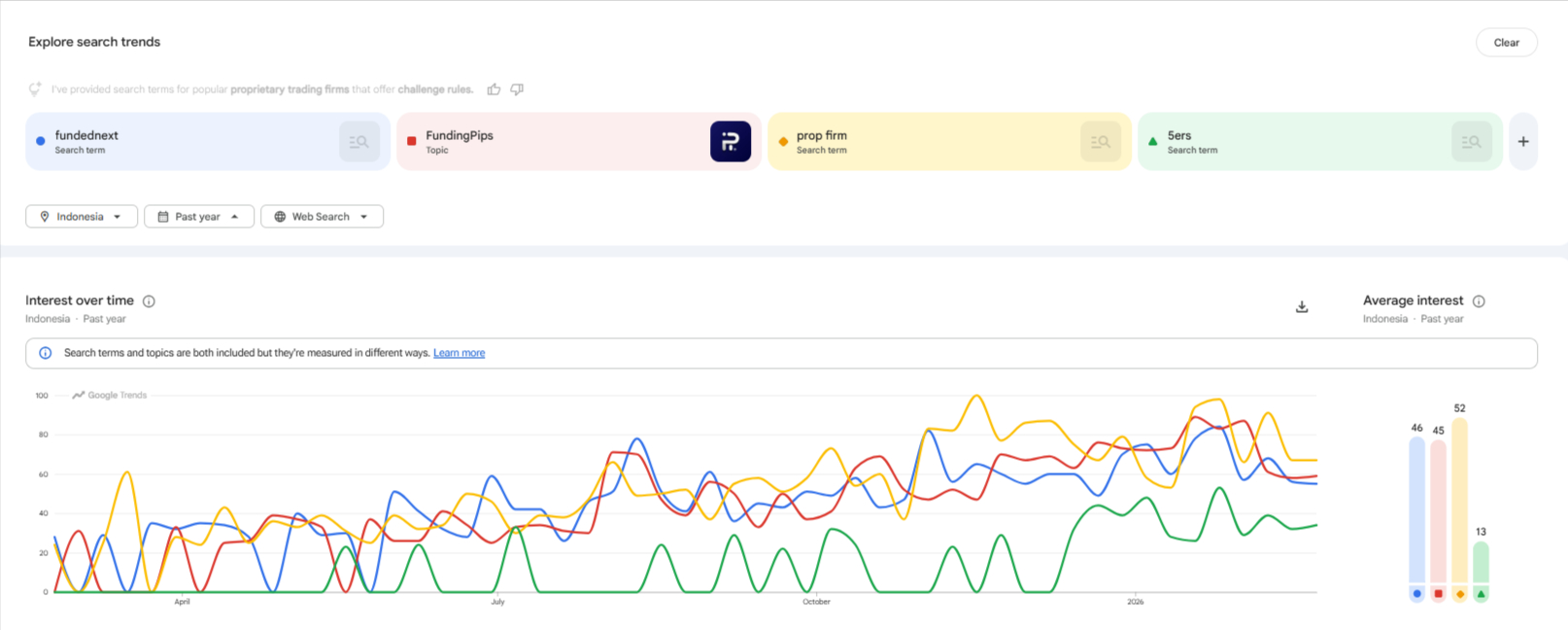 Prop firm search terms in the last year in Indonesia[/caption]
Why does Indonesia’s digital profile matter for prop firms?
Indonesia’s digital profile matters because prop trading is a distribution business before it is a platform business. If the audience is online, mobile, social, and comfortable transacting digitally, acquisition and retention become much more realistic.
DataReportal’s Digital 2026 report says Indonesia had 230 million internet users by the end of 2025, which equates to 80.5% penetration. It also reports 180 million social media user identities in late 2025.
That matters for more than broad fintech optimism.
Prop firms rely heavily on digital behaviors that overlap with this profile:
- traders discover firms through search, YouTube, Telegram, Discord, TikTok, and affiliates
- users compare rules, payout terms, dashboards, and pricing online before they ever buy
- support, education, and community are usually delivered digitally
- trust is built through content, reviews, and transparent comparison pages
A market with strong mobile usage and heavy social platform participation gives prop firms a much better base for education, acquisition, and repeat engagement.
That does not automatically create trader quality. It does create reach.
What does Robinhood’s Indonesia move actually tell us?
Robinhood’s move matters because it is a real capital-allocation signal, not just social chatter. Large public trading companies do not usually enter regulated markets unless they believe the long-term opportunity is worth the complexity.
On December 7, 2025, Robinhood announced agreements to acquire PT Buana Capital Sekuritas and PT Pedagang Aset Kripto as its entry point into Indonesia. In the announcement, Robinhood described Indonesia as a “fast-growing market for trading” and said the deals were expected to close in the first half of 2026, subject to approvals.
This does not prove that prop trading itself is mature in Indonesia. That would be an overclaim.
What it does show is that a major trading platform sees Indonesia as strategically important enough to justify local market entry. That supports the broader thesis: if serious players are willing to build regulated infrastructure in the market, they see durable demand ahead.
For the wider trading ecosystem, that matters. Brokers, educators, tech vendors, payment providers, and prop firms tend to follow markets that already show traction.
Is Indonesia following the same path as India?
Indonesia is not India, but the pattern is familiar enough to take seriously. The common thread is not geography. It is the mix of demographics, digital adoption, and increasing market participation.
India became impossible for the trading industry to ignore once a few things became obvious:
- the user base was young
- the market was increasingly app-native
- retail participation became too large to dismiss
- trading businesses started building for the local user, not just translating a homepage
Indonesia is showing earlier-stage versions of those same signals.
The comparison should stay disciplined. Indonesia has its own regulatory environment, payment behavior, education gaps, and trust issues. But if you want a rough strategic frame, this is the useful one: Indonesia looks less like a fringe market and more like a market entering its serious build phase.
That is the point.
Is Indonesia already a mature prop trading market?
No. Indonesia looks early-stage, not fully mature, which is exactly why the market is strategically interesting now rather than five years ago. The opportunity is tied to growth potential, not to a finished ecosystem.
There are still obvious constraints.
Trust remains a major issue in trading-related categories. Search results are full of branded pages, aggressive offers, and uneven education quality. That usually means users still need help distinguishing between marketing noise and credible information.
The market also needs more than localized sales pages. It needs:
- clearer trader education
- better comparison frameworks
- transparent rule explanations
- more trust signals around funding models and payouts
- stronger local-language support
That gap is not a weakness for publishers. It is the opportunity.
The sites that win in this phase are usually the ones that make the market easier to understand.
Why was FundedTrading.id built for this market?
FundedTrading.id makes sense because Indonesia now needs clearer, more locally relevant prop trading content than the market usually gets from generic global landing pages. That is both a user need and an SEO opportunity.
Most prop firm content still falls into one of two buckets:
- thin affiliate content dressed up as education
- branded firm pages designed to convert, not explain
That leaves a large gap for independent content that helps Indonesian traders understand how prop firms work, how rules differ, where the risks sit, and what questions matter before paying for a challenge.
That is where FundedTrading.id can actually be useful.
The strategic goal should be simple: become the site that explains funded trading clearly for Indonesian users before trying to monetize them. If you do that well, rankings, trust, and commercial value tend to follow.
What should prop firms and brokers do next in Indonesia?
The firms that win in Indonesia will probably be the ones that localize deeper than surface-level translation. This market looks large enough to matter, but still early enough that trust and clarity will shape who earns attention.
That means doing the unglamorous work properly:
- local-language education
- transparent challenge rules
- payout clarity
- realistic risk disclosures
- fast support
- payment and onboarding that fit local expectations
This is where a lot of firms get lazy. They assume a translated landing page is localization. It is not.
In a developing prop trading market, the winners are usually the firms that reduce confusion first.
FAQs
Is prop trading popular in Indonesia yet?
Prop trading is growing in visibility in Indonesia, but it is still earlier-stage than markets with longer retail trading histories. The stronger claim is that Indonesia now shows the conditions that can support much larger prop trading demand.
Why are young investors important for prop firms?
Younger investors tend to be more comfortable with mobile-first platforms, digital onboarding, online education, and testing different trading models. That makes them more likely to engage with funded trading than older, less digitally native audiences.
Does Robinhood entering Indonesia prove the prop market is mature?
No. It does not prove prop market maturity. It does show that a major trading platform sees Indonesia as strategically important enough to justify market entry and regulatory effort.
What is the biggest opportunity for FundedTrading.id?
The biggest opportunity is becoming the clearest Indonesian-language resource for understanding prop firms, funded challenges, rules, and comparisons. In messy markets, clarity is often the best growth strategy.
Media Contact:
Alex Firdaus
Head of Media
FinMedia Group
af@finmediagroup.com