You can be great at reading charts and still fail every prop firm challenge. Industry data shows that 90% of retail traders fail. In prop firms, the failure rate is likely even higher. This is not because traders cannot read a chart. It happens because of one specific thing that does not exist in personal accounts: Strict Risk Rules.
Most new traders make a mistake. They have a "strategy," which tells them when to buy or sell. But they do not have a "plan." A plan is a full business guide. It helps you manage your losses, keep your money safe, and handle the pressure of trading someone else's capital. Without a professional plan, you are almost guaranteed to hit the maximum loss limit. This guide helps you build a trading plan specifically designed to pass evaluations (like Funding Pips or FTMO) and keep your funded account.
Why You Fail Prop Challenges Without a Written Plan
The main reason traders fail in this environment is that they misunderstand the game. You are not playing for "maximum profit." You are playing for "survival."
The Prop Firm Difference
In your own personal account, you can hold a losing trade for weeks. You can wait for the price to come back. In proprietary trading, you cannot do that. A 5% drop in one day usually means you lose the account immediately. For example, in the Funding Pips 2-Step Model, hitting a 5% Maximum Daily Loss is a hard rule. If you hit it, you are out. A trading plan helps you play defense so you never cross that line.
Too Many Decisions vs. A Clear Path
Without a written plan, you have to make a new decision every time the market moves. This makes your brain tired. When you get tired, you might freeze and miss a good trade. Or, you might make a bad trade just because you want to feel active. A written plan fixes this. It changes your job from "thinking about everything" to simply "following the checklist."
The "Casino" Mentality
If you do not have written rules for risk, you are not a manager. You are a gambler. The market is a game of chances. A plan forces you to treat trading like a real business with clear costs. Without it, you are just betting and hoping the algorithm pays you before you break the rules.
Pillar 1: Defining Your "Edge" and Setup Criteria
You cannot trade everything. The first step in your plan is to choose exactly what you will trade and ignore the rest.
Focus on One Setup
Do not try to trade every style at once. Your plan should list one "A+ Setup" with strict rules. If the market does not look exactly like your picture, you do not trade. This discipline stops you from taking bad trades that usually cause big losses.
Choosing Your Assets
You must pick assets that move enough to make money but do not cost too much to trade. Different firms offer different things. For instance, Funding Pips allows you to trade FX, Metals, Indices, Energy, and Crypto.
You must also think about the cost. If you trade often (scalping), commissions are important. Funding Pips charges $2 per lot for FX and Metals on their 1-Step and 2-Step models. However, there is no commission for Indices or Energy. If you want to avoid extra fees, you might choose to trade Indices.
Platform and Execution
Your plan must also list the software you use. You need a tool you know well so you do not make mistakes when the market moves fast. Funding Pips lets you choose between cTrader, Match Trader, and MT5. Pick the one that is easiest for you to use.
Timeframe Rules
To avoid losing money when the market is slow and choppy, your plan must say exactly when you are allowed to trade. Professional traders often only trade during busy times, like the London Open or the New York session. This ensures there are enough buyers and sellers to move the price to your target quickly.
Pillar 2: Risk Management (The Survival Math)
Risk management is the math that keeps you alive in this game. If you get the math wrong, your trading skill does not matter.
The "Hard Breach" Reality
In a prop firm, hitting your Maximum Daily Loss
is the end of the game. It is called a "hard breach." If you hit this limit, you lose your account immediately. You cannot simply wait for the market to come back tomorrow. Your plan must be built to stay far away from this line.
Position Sizing for Drawdown
You cannot guess how much to bet on a trade. You must use math.
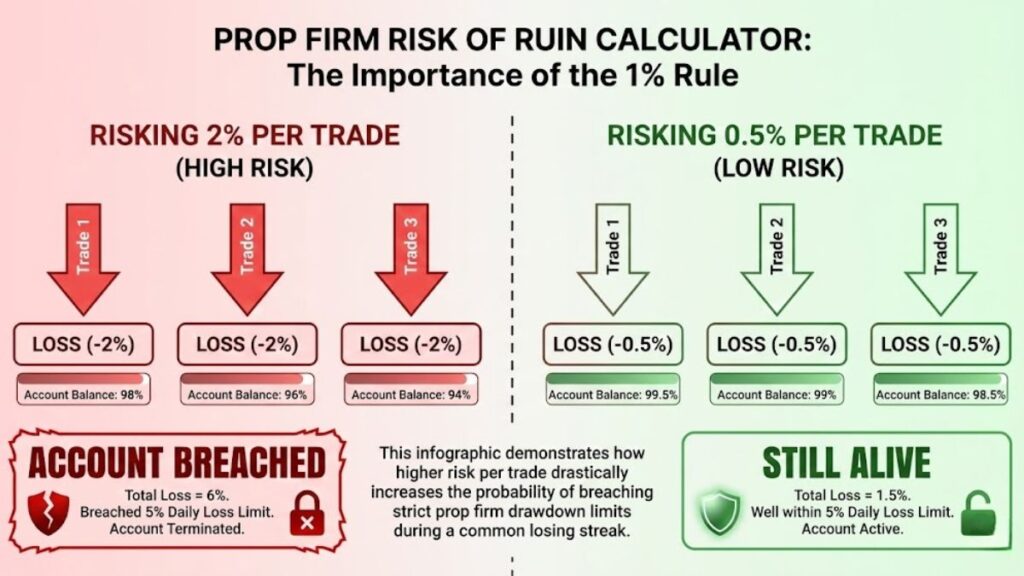
- Rule: Never risk more than 1% of your account on a single trade. If you have a $100,000 account, you should never lose more than $1,000 on one idea.
- Funding Pips Specific: This firm has a strict 3% Rule. This means no single loss should ever be bigger than 3% of your account size. If you usually risk 1%, you are safe. But if you trade without a stop loss and a big crash happens, you could break this rule and lose your account instantly.
The Daily Circuit Breaker
You need a rule to stop yourself when you are having a bad day. We call this a "circuit breaker." A good rule is to stop trading completely after 2 losses in a row. If you lose 2% today, walk away. This saves your mental energy and protects your account so you can trade again tomorrow.
Leverage Awareness
Leverage changes how big your position can be. You need to know your limits. For example, Funding Pips offers 1:100 leverage for FX if you choose the 2-Step Model. However, if you choose the 1-Step Model, the leverage for FX is lower at 1:50. You must adjust your lot sizes based on which account you choose.
Pillar 3: Routine & Execution (Pre & Post Market)
Professional traders have a routine. Gamblers just guess. Your plan needs a schedule.
Pre-Market Routine
Before you open a chart, you must check the Economic Calendar. Look for "Red Folder" news events. These are high-impact events that make the market move fast.
- News Trading Rules: You must check the rules for your specific account. For Funding Pips, you are allowed to trade during news in the Evaluation Phase. But once you have a Funded Account, there are restrictions. You cannot count profits from trades that were opened less than 5 hours before news and closed 5 minutes before or after high-impact news. Knowing this rule prevents you from making profits that the firm will delete later.
Execution Rules
- Use Limit Orders: Try to use Limit Orders instead of Market Orders. This helps you get the exact price you want and avoids "slippage," which is when the price changes while you are clicking the button.
- Automation: You do not have to do everything manually. Expert Advisors (EAs) are allowed at Funding Pips as long as they are used as trade or risk managers. This means you can use software to set your stop loss automatically, but you cannot use a bot that trades for you completely.
Post-Market Review
After you finish trading, write down how you felt. Were you scared? Were you greedy?
- Checking "Inactivity Rules": Do not forget to trade at least once a month. Funding Pips requires you to open and close at least one trade every 30 days. If you forget this, you will lose your account for inactivity.
Real-World Strategy: The "Squint Test" for Funding Pips
A trading plan needs a strategy that fits the specific rules of your prop firm. You cannot trade a high-frequency scalping system on a firm that has strict commission structures.
Here is a proven strategy designed specifically for the Funding Pips 2-Step Model. We call it the "Squint Test" Supply & Demand system. It is optimized to respect the 5% Daily Drawdown limit
and take advantage of the specific asset classes Funding Pips offers.
1. The Setup (What to Trade)
- Instruments: Focus on the major US Indices: US30, NAS100, and US500.
- Why Funding Pips? Funding Pips offers commission-free trading on Indices. If you traded this same strategy on FX, you would pay $2 per lot. By choosing Indices, you keep 100% of your profit, which helps you hit the 8% Profit Target faster.
- Timeframe: Use the 15-Minute chart.
- Leverage Awareness: Funding Pips offers 1:20 leverage on Indices. You must calculate your lot size carefully. A 1:20 leverage is lower than FX (1:100), so you cannot open massive positions without eating up your free margin.
2. The "Squint Test" Rule
Most traders fail the Evaluation Stage
because they overtrade. They see zones everywhere.
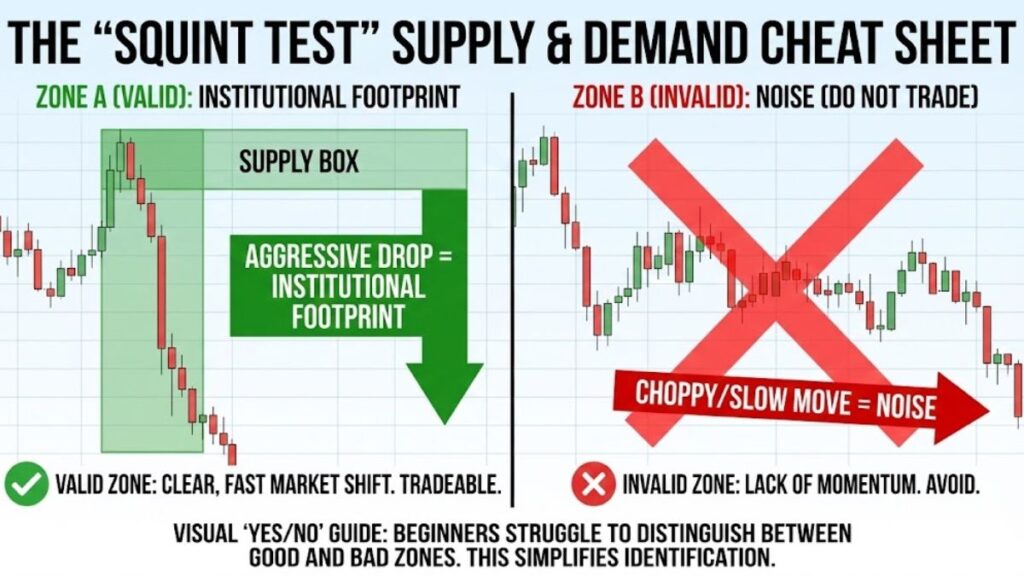
- The Rule: If you have to squint your eyes, zoom in, or ask "is this a zone?", then it is not a zone. Delete it.
- What to Look For: You are looking for a move so aggressive that it leaves a large gap.
- Supply (Sell Zone): Look for a sharp drop away from a level. Draw your box from the peak to the last green candle.
- Demand (Buy Zone): Look for an explosive rally. Draw your box from the bottom to the last red candle.
3. The Execution (The Routine)
This routine is built to avoid the Inactivity Rule
(must trade once every 30 days) and preventing "tilt."
- When to Analyze: Open your charts 1 hour after the New York market closes.
- Set Limit Orders: Place a Limit Order at the edge of your zone.
- Note on News: If you are in the Evaluation Phase, you can leave these orders open during news. However, once you are in the Funded Stage, you must be careful. Funding Pips does not count profits from trades opened less than 5 hours before high-impact news. Since these are Limit Orders set the night before, they usually satisfy the "5-hour" rule, making this strategy safer for funded traders.
- Target: Set your Take Profit at 1:2 Risk-to-Reward.
4. Why This Wins the Funding Pips Challenge
- Respects the 3% Rule: Funding Pips has a rule that no single loss can exceed 3% of your account size. By using a fixed 1% risk per trade with this strategy, you are always safe from this violation.
- Consistent Growth: For the Funding Pips Zero account, there is a 15% consistency rule (no single day can be >15% of total profit). This strategy aims for steady 1:2 wins rather than one massive "lucky" trade, keeping your consistency score healthy so you can actually get paid.
- Diversification: By scanning all three indices (US30, NAS, US500), you smooth out your results. If one index is messy, another might give you the perfect setup.
Common Pitfalls That Destroy Plans
Even with a perfect plan, you can still fail if you fall into common traps. These are the mistakes that cause traders to lose their funded accounts even after they pass the evaluation.
Style Drift
This happens when you lose two trades in a row and immediately change your strategy. You start adding new indicators or watching YouTube videos for a "better" way.
- The Fix: You must commit to your plan for at least 100 trades. You cannot judge a strategy based on one bad week. If you switch strategies constantly, you will never know if your edge actually works.
Ignoring Consistency Rules
Prop firms like Funding Pips have specific rules to stop gambling. They do not want you to pass a challenge with one lucky trade.
- The Funding Pips Rule: For the Zero Account, your biggest winning day cannot be more than 15% of your total profits. If you make $10,000 profit, but $5,000 of it came from one lucky day, you might be denied a payout. For On-Demand payouts, no single day can account for more than 35% of the total profit.
- The Fix: Do not try to pass the challenge in one giant trade. Aim for steady, small wins. If you hit a massive home run, it might actually hurt your consistency score and prevent you from getting paid.
Revenge Trading
This is the number one account killer. It happens when you hit your daily loss limit but keep trading to "make it back."
- The Fix: You must respect the Circuit Breaker. If your plan says "Stop after 2 losses," you must close the laptop immediately. The market will be there tomorrow. If you keep trading, your account will not be.
Step-by-Step Checklist to Write Your Plan Today
Do not overcomplicate this process. Open a document or a notebook and answer these four questions right now.
- What is my Setup? (Example: "I trade the Squint Test Supply & Demand on US Indices.")
- What is my Hard Risk Limit? (Example: "I risk 1% per trade. I stop trading if I lose 2% in one day.")
- What are my Filters? (Example: "I do not open new trades 5 minutes before Red Folder news events.")
- When do I review? (Example: "Every Sunday, I check my journal to see if I followed my rules.")
Conclusion
A trading plan is not a homework assignment. It is a contract between you and your future success. The goal of a funded trader is not to make a million dollars overnight. The goal is to protect your capital so you can stay in the game long enough for your edge to work.
If you follow the risk rules in this guide, respect the hard drawdown limits, and execute your strategy with patience, you will put yourself in the top 1% of traders who actually get paid. Start writing your plan today.
Ready to Start Your Challenge?
You now have the plan, the strategy, and the risk management rules. The only thing left is to execute.
If you are ready to test your skills with Funding Pips, we have secured a discount to help you get started with less upfront cost.
- Visit our Funding Pips Hub: Read our full review, see the latest updates, and get the direct link to start your challenge.
- Exclusive Offer: Use code FTR at checkout to get 20% OFF your evaluation.
> Go to the Funding Pips Hub & Claim Your 20% Discount
Frequently Asked Questions
What should be in a prop firm trading plan?
A good prop firm trading plan must have three main parts:
- A specific setup: Knowing exactly when to buy or sell (like the Supply & Demand strategy).
- Risk rules: A hard limit on how much you can lose in one day (e.g., "I stop trading if I lose 2%").
- Routine: A schedule for when you analyze the market and when you review your trades.
How much should I risk per trade on a funded account?
You should never risk more than 0.5% to 1% of your account on a single trade. Most prop firms, like Funding Pips, will close your account if you lose 5% in one day. If you risk 2% per trade, a small losing streak of just 3 trades could make you fail the challenge.
Does Funding Pips allow news trading?
It depends on your account stage.
- Evaluation Phase: Yes, you can trade during news.
- Funded Phase: You usually cannot take profits from trades opened less than 5 minutes before or after high-impact news.
- Zero Account: News trading is generally not allowed. Always check your specific account dashboard to be sure.
Why do most traders fail prop firm challenges?
Most traders fail because they break the Daily Drawdown Rule. They do not fail because they are bad at guessing the price. They fail because they get angry after a loss, increase their lot size to "make it back," and hit the 5% loss limit in one session.
Can I use a trading bot (EA) on Funding Pips?
Yes, but with strict rules. You can use Expert Advisors (EAs) that help you manage risk or calculate lot sizes. However, you generally cannot use fully automated "black box" bots that trade for you, and you cannot use "high-frequency trading" (HFT) bots.
What is the best strategy for passing a Funding Pips challenge?
The best strategy is one that is boring and consistent. High-risk strategies might pass the first phase quickly, but they usually fail the consistency rules later. A simple Supply & Demand strategy (like the "Squint Test") with a 1:2 Risk-to-Reward ratio is often the best choice for long-term success.