



By Alex Firdaus · Updated June 2026 · Data checked June 2026
How to Get a Funded Trading Account in 2026
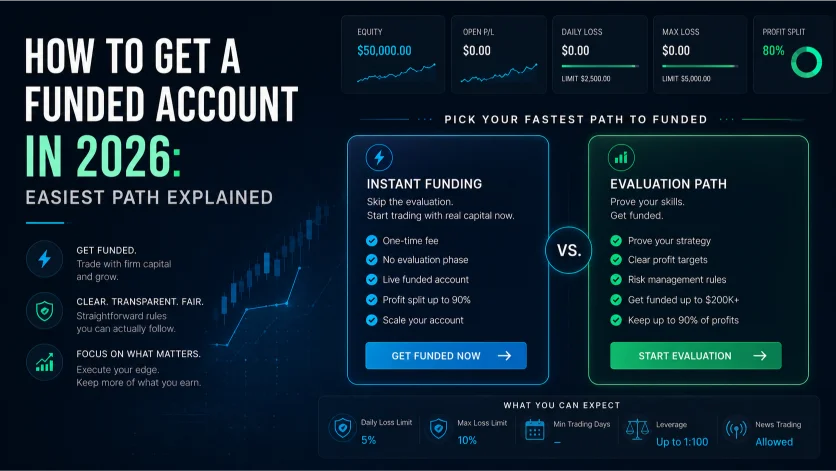
Short answer: You get a funded trading account by either passing a prop firm evaluation challenge or buying direct access through an instant funding program. Most evaluations require hitting an 8 to 10 percent profit target while keeping your losses within a 4 to 10 percent drawdown limit. The right route depends on your budget, your strategy, and how well you handle rule-based risk management.
Table of Contents
What is a funded trading account?
A funded trading account is an account provided by a proprietary trading firm that gives you access to the firm's capital to trade. You follow the firm's risk rules, keep a set percentage of the profits you generate, and do not need to deposit your own trading capital to get started.
In most funded programs, the split is between 70 and 90 percent in your favor. So if you generate $2,000 in profit on a $100,000 funded account with an 80 percent split, you receive $1,600.
That does not mean you are trading for free. Every funded account comes with rules. Break them and the account closes. Common rules include:
- A maximum daily loss limit, usually 3 to 5 percent of the account
- A maximum total drawdown, usually 6 to 10 percent
- Restrictions on holding trades over weekends or during news events
- Minimum trading day requirements before you can request a payout
- Consistency rules that cap how much of your profit can come from a single day
The firm is not giving you free capital out of generosity. They make money from challenge fees, resets, and in some cases from the trading activity itself. Understanding that business model helps you evaluate whether a specific firm's rules are fair to work with.
The two routes to getting funded
There are two main ways to get a funded trading account. Each suits a different type of trader.
Route 1: Evaluation challenge
You pay a one-time fee to access a simulated account. You then trade toward a profit target, typically 8 to 10 percent, without breaching the daily or maximum drawdown limits. Most firms use a 1-step or 2-step structure. Pass and you receive a funded account.
Evaluation fees usually run between $50 and $150 for smaller account sizes. On a $100,000 account, expect to pay $100 to $300 depending on the firm. Some firms refund the fee on your first payout.
Route 2: Instant funding
You pay for access to a funded account directly with no evaluation to pass first. You start trading under the firm's rules immediately. Instant funding accounts cost more upfront because you are paying for the access itself, not just the evaluation.
The trade-off is that instant funding often comes with tighter drawdown limits or a trailing drawdown model that can be more punishing than standard evaluation-based accounts.
For a full breakdown, read instant funding vs evaluation and best no-evaluation prop firms.
How to qualify: step-by-step
These steps apply to the evaluation route, which is where most traders start. Follow them in order and you improve your odds of passing on the first attempt.
-
1Pick a firm whose rules match your trading style
Check whether the firm allows your strategy before buying. If you trade news events, hold overnight, use EAs, or copy trade, verify those are permitted. Buying an evaluation and then discovering your strategy is restricted is a common and avoidable mistake.
-
2Read the drawdown model in full
Static drawdown limits are set from the account's starting balance and never move. Trailing drawdown limits move upward as your equity grows, which can make them much harder to manage for active traders. Know which one applies before you pay. See prop firm drawdown rules explained for the full breakdown.
-
3Set your position sizing before the first trade
Work backward from the drawdown limit. If the daily loss limit is 5 percent and you risk 1 percent per trade, you can lose 5 trades before the account closes for the day. Most traders who fail evaluations do so because one or two bad sessions push them into a limit they had not planned for.
-
4Trade your normal strategy, not a faster one
The most common evaluation failure is changing strategy because the challenge feels like a race. Trading more frequently, sizing up, or chasing setups to hit the target faster almost always backfires. The profit target matters less than staying inside the loss limits long enough to reach it.
-
5Complete minimum trading days if required
Some firms require a minimum number of trading days before you can pass. This is separate from the profit target. Hitting 10 percent profit in two sessions might not qualify if the firm requires 10 minimum trading days. Check this rule before starting.
-
6Request your funded account and apply the same discipline
Passing the evaluation is the beginning, not the finish line. Most traders who fail funded accounts do so because they relax on risk management after the challenge ends. The same rules that got you through the evaluation will keep the account alive.
What to check before paying for any program
Before handing over a challenge fee, verify these five things. They matter more than the headline account size.
| What to check | Why it matters | What to look for |
|---|---|---|
| Drawdown model | Determines how much room you have before the account closes | Static vs trailing. Trailing is tighter for active traders. |
| Strategy restrictions | Some strategies are banned outright | Check: news trading, EAs, copy trading, overnight holds, lot limits |
| Payout rules | Determines when and how you can withdraw profits | First payout date, minimum payout amount, payout processor (Deel, Rise, bank wire) |
| Platform availability | Not all firms support all platforms | Check for MT5, cTrader, TradeLocker, DXtrade, or futures-specific platforms |
| Firm reputation | Some firms deny payouts or change rules after the fact | Look for payout evidence in trading communities, clear rule documentation, and how long the firm has been operating |
For a full vetting checklist, read how to tell if a prop firm is legitimate and 9 things to know before joining a prop firm.
Mistakes that lose funded accounts fast
Most funded accounts do not fail because of one bad decision. They fail because a pattern of small mistakes stacks up until the account hits a limit or breaks a rule. These are the most common patterns.
What keeps accounts alive
- Risking 0.5 to 1 percent per trade maximum
- Trading the same strategy used in the evaluation
- Stopping for the day after hitting the daily loss limit
- Reading payout rules before placing the first funded trade
- Knowing the difference between balance and equity drawdown
What kills accounts fast
- Oversizing positions because the account feels "not real"
- Chasing payout targets by trading more setups than usual
- Trading news without checking the firm's news trading rules
- Ignoring the trailing drawdown on high-equity days
- Buying instant funding without reading the drawdown model first
For a detailed breakdown of common failure patterns, see 14 trading mistakes that fail prop firm challenges.
Is a funded account worth it?
A funded account is worth the entry cost if you already have a strategy that produces consistent results on a personal account and you need more buying power than you can fund yourself. It is not worth it if you are still learning to manage risk, control losses, or follow rules under pressure.
The prop firm model makes sense for a specific type of trader:
- You have a repeatable edge that does not require outsized risk per trade
- You can follow fixed rules without adjusting them mid-challenge
- You understand the economics of challenge fees versus potential payout
For traders who are still developing their strategy, the more likely outcome is a cycle of challenge fees with no funded account to show for it. That does not mean funded trading is not right for you long term. It means the timing matters.
If you are starting out, read how to start forex trading with prop firms before buying your first evaluation. Understanding the structure first saves money.
What about options and futures funded accounts?
Options and futures funded accounts work on the same evaluation model but use futures-specific platforms like Rithmic or Tradovate. The profit targets and drawdown limits are usually quoted in dollar amounts rather than percentages, and the instruments traded are futures contracts rather than spot forex. If you trade futures, make sure the firm explicitly supports CME instruments and check whether the drawdown is intraday or end-of-day, since that changes how much room you have on any given session.
Frequently asked questions
What is a funded trading account?
A funded trading account is a prop firm account that lets you trade using the firm's capital under a defined set of risk rules. You keep an agreed share of profits, typically 70 to 90 percent, without needing to deposit your own trading capital. See funded trading rules and parameters explained for the full structure.
How do you get approved for a funded trading account?
You get approved by either passing a prop firm evaluation challenge or purchasing direct access through an instant funding program. Evaluation accounts require you to hit a profit target, usually 8 to 10 percent, while staying within daily and maximum drawdown limits. Instant funding accounts give immediate access in exchange for a higher upfront cost.
How do I qualify for a funded trading account with a prop firm?
To qualify through an evaluation, hit the profit target without breaching the daily loss limit or maximum drawdown. Some firms also require a minimum number of trading days and apply consistency rules that prevent a single day from making up the majority of your total profit. Read the full rules document from any firm before paying the fee.
What is the cheapest way to get a funded account?
The cheapest entry point is a low-cost evaluation account, not an instant funding account. Evaluation fees start from around $50 for small account sizes. Instant funding costs more upfront because you are paying for skipping the challenge, not just proving your ability.
Can you get a funded account without passing a challenge?
Yes. Instant funding and no-evaluation prop firms give you direct account access. You skip the challenge but usually pay more and trade under tighter rules. See best no-evaluation prop firms for a reviewed list of options.
How long does it take to get a funded account?
Instant funding accounts are accessible within hours of payment. Evaluation-based accounts typically take 2 to 6 weeks to complete, depending on account size, firm rules, and how consistently you reach the profit target. Some firms have no time limit on evaluations, which removes the pressure to rush.
How to get a funded forex trading account specifically?
The process is the same as any funded account. Choose a prop firm that offers forex instruments, verify that your target pairs are available (most firms support major forex pairs and XAUUSD), and confirm the platform matches what you trade on, whether that is MetaTrader 5, cTrader, TradeLocker, or DXtrade. Then follow the evaluation or instant funding path.
Is a funded trading account risk-free?
No. You are still risking the evaluation fee, your time, and the account itself if you break the rules or trade poorly. The funded model removes your need to risk personal trading capital, but it does not protect you from losing fees or accounts through poor execution or rule violations.
How to buy a funded trading account?
You can buy direct access to a funded trading account through instant funding or no-evaluation programs offered by prop firms. Go to the firm's website, select the account size, pay the program fee, and you receive account credentials after the firm processes your purchase. FundedTrading reviews instant funding options at best instant funding prop firms.
Find the Right Prop Firm for Your Strategy
Compare evaluation fees, drawdown models, platforms, and payout rules across 160+ reviewed prop firms.
See All Prop Firm Reviews