



By Alex Firdaus | Updated July 2026
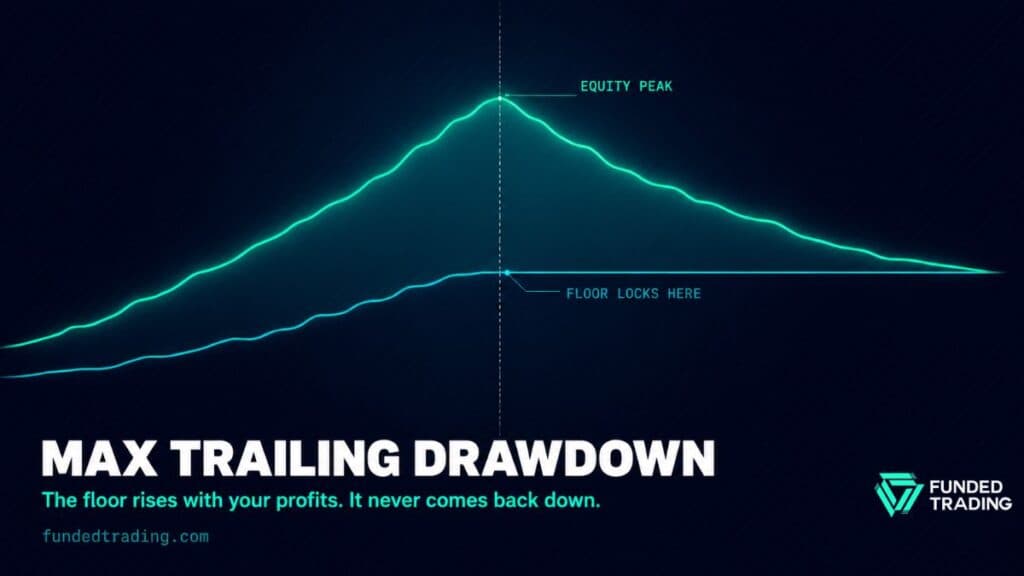
Max trailing drawdown is the rule that closes more funded accounts than any other. The floor follows your highest equity peak and never comes back down. Touch it once and the account is gone.
Most traders who violate it understand the basic concept. What they miss is which type of trailing drawdown their firm uses, because intraday trailing and end-of-day trailing are two completely different environments to trade in.
Table of Contents
- What Is Max Trailing Drawdown?
- The Three Types of Trailing Drawdown
- Balance-Based vs Equity-Based Enforcement
- How to Calculate Your Trailing Drawdown Floor
- The Scratch Trade Trap (Intraday Accounts Only)
- Trailing vs Static Drawdown: Which Is Harder?
- How to Stay Within a Trailing Drawdown Limit
- Common Mistakes That Trigger Violations
- FAQ
What Is Max Trailing Drawdown in Prop Trading?
Max trailing drawdown (MTD) is a dynamic loss limit used by prop firms. The firm sets a fixed dollar buffer below your account's highest point. That floor moves up with every new equity high. It never moves back down.
The floor is sometimes called the high-water mark floor, trailing threshold, or maximum loss limit, depending on the firm. The rule itself is always the same: highest balance minus the allowed drawdown amount equals the floor. Drop below it for even one tick and the account closes instantly.
The key practical difference: with trailing drawdown, profits tighten the gap between your current equity and the floor. With static drawdown, profits widen it.
Trailing drawdown is used by firms like FundedNext (Stellar Instant accounts use a 6% locked-in trailing model; their Stellar 1-Step and 2-Step use static drawdown), Maven Trading (instant funded accounts use intraday equity-based trailing), and several futures-focused firms as their primary risk control. FTMO uses a static 10% max drawdown anchored to the initial balance, which is why traders moving between firms often underestimate how much harder trailing accounts are to manage.
The Three Types of Trailing Drawdown (And Why the Difference Matters)
Most guides on trailing drawdown treat it as a single rule. It is not. There are three distinct models in use across prop firms in 2026, and they create very different trading environments. Picking the wrong account type for your trading style is a fast way to lose the evaluation.
Intraday Trailing Drawdown
The floor updates continuously during the session, based on the highest equity your account reaches at any point, including unrealized profit from open positions. The moment your equity peaks, the floor rises. If the trade reverses and your equity drops below the new floor, the account closes. This happens even if you are still profitable for the day overall.
Intraday trailing is the strictest model. It suits scalpers who take quick profits and rarely hold through significant pullbacks. Firms using intraday trailing at the futures end include Apex Trader Funding (standard option), TakeProfitTrader (PRO accounts), and Tradeify (on certain account tiers). Always verify by reading the full account terms before funding.
End-of-Day (EOD) Trailing Drawdown
The floor updates once per session, based on your closing balance only. Intraday equity swings do not affect the floor as long as you finish the session above it. If you are up $3,000 mid-session, pull back to +$800, and close the day at +$800, the floor moves by $800. The $3,000 intraday peak is not recorded.
EOD trailing is significantly more forgiving than intraday for traders who hold through normal market noise. A trade that peaks at $4,000 and closes at $1,500 costs you $1,500 of buffer, not $4,000. This is the critical difference that determines whether swing-style trading is viable on a given account.
The floor still rises over time as the account grows. EOD trailing is not static. The distinction from intraday is where and when the floor moves, not whether it moves at all.
Locked-In Trailing Drawdown (Trails to Balance)
This model starts as a standard trailing drawdown. The floor rises with equity peaks as normal. But once the floor reaches the original starting account balance, it locks. The trail stops. The floor becomes fixed at the initial balance and behaves like a static drawdown from that point forward.
Example: $100,000 account with 5% trailing drawdown. Floor starts at $95,000. As the account grows to $110,000, the floor rises to $105,000. Then to $115,000. Eventually the account grows enough that the floor passes $100,000. At that point the floor locks at $100,000. It stops tracking peaks. The account now has a $100,000 static floor for the rest of the evaluation or funded period.
Some firms describe this as "trailing to initial balance" or "trailing drawdown with a hard floor at starting balance." It is one of the more trader-friendly trailing structures. E8 Markets Signature accounts use a version of this model — EOD trailing that locks static once your realized profit equals the initial drawdown threshold. E8 One accounts use intraday trailing instead. Always verify the current rules on your specific account type before funding.
| Type | When Floor Updates | Intraday Peaks Counted? | Floor Locks At? | Difficulty |
|---|---|---|---|---|
| Intraday Trailing | Real time, every tick | Yes | Never | Hardest |
| EOD Trailing | Session close only | No | Never | Moderate |
| Locked-In Trailing | Until floor hits starting balance | Varies by firm | Starting account balance | Moderate to Easy |
| Static (Fixed) | Never moves | N/A | Locked from day 1 | Easiest |
Balance-Based vs Equity-Based: How the Floor Actually Triggers
Knowing the type of trailing drawdown is step one. Step two is understanding what the firm measures against the floor. This is the second variable most traders overlook.
The overwhelming majority of prop firms use equity-based enforcement. On a $100,000 account with a $95,000 floor, one open trade sitting at -$5,001 closes the account, even if the position would have recovered in the next five minutes.
If you plan to hold positions through news events, carry trades overnight, or trade instruments with wide spreads, equity-based accounts require much tighter position sizing than balance-based accounts at the same drawdown percentage.
How to Calculate Your Trailing Drawdown Floor
The formula is the same regardless of which trailing type your firm uses. What changes is when the floor updates.
Drawdown dollar amount = Account size x Trailing drawdown %
Floor = Highest recorded equity (or balance) minus drawdown dollar amount
Example 1 — $100,000 Account, 5% Trailing Drawdown
Drawdown dollar amount: $100,000 x 5% = $5,000
| Event | Account Value | Floor | Buffer Left |
|---|---|---|---|
| Account starts | $100,000 | $95,000 | $5,000 |
| Grows to $104,000 | $104,000 | $99,000 | $5,000 |
| Drops back to $100,000 | $100,000 | $99,000 | $1,000 |
| Drops to $98,999 | $98,999 | $99,000 | Violated |
Look at row 3. The account is back at $100,000, the exact starting balance. But the floor has risen to $99,000 during the growth phase. The trader has only $1,000 of buffer left while sitting at their opening balance. This is the part most traders fail to account for when sizing positions.
Example 2 — $50,000 Account, 10% Trailing Drawdown
Drawdown dollar amount: $50,000 x 10% = $5,000
| Event | Account Value | Floor | Buffer Left |
|---|---|---|---|
| Account starts | $50,000 | $45,000 | $5,000 |
| Grows to $55,000 | $55,000 | $50,000 | $5,000 |
| Drops back to $50,500 | $50,500 | $50,000 | $500 |
| One losing trade at -$600 | $49,900 | $50,000 | Violated |
After one good run to $55,000 and a full retracement, the buffer collapses from $5,000 to $500 the moment the account is back near where it started. A single bad trade from there closes the account. The 10% trailing drawdown gave significantly less room than traders expect after a profitable stretch followed by a pullback.
The Scratch Trade Trap: Losing Buffer on Break-Even Trades
This mechanic is specific to intraday trailing drawdown accounts, and it is the single most misunderstood aspect of prop firm risk rules. On an intraday account, you can lose a meaningful chunk of your buffer on a trade that closes at break-even.
Here is the sequence on a $50,000 account with a $2,500 trailing drawdown (floor starts at $47,500):
- You open a trade. It moves $2,000 in your favor. Equity reaches $52,000.
- The floor rises instantly to $49,500. (Intraday model: floor moves with every equity peak.)
- The trade reverses. You close it at break-even. Account back at $50,000.
- Your floor is now $49,500. Buffer left: $500. Not $2,500.
You made zero dollars on the trade. You lost $2,000 of drawdown buffer. The next trade that moves $600 against you closes the account.
This is how traders with profitable strategies fail intraday trailing evaluations. They run their normal approach, hold a winner through a pullback, close it for a scratch, and suddenly have no room to operate. The account did not blow up from a losing trade. It ran out of buffer from the mechanical interaction between intraday trailing and an unrealized gain that reversed.
Traders who run mean-reversion strategies, who hold through intraday swings, or who let winners run before taking profit will almost always perform better on EOD or static accounts than on intraday trailing accounts.
Trailing vs Static Drawdown: Which Is Harder to Trade?
Trailing drawdown is harder to manage than static drawdown for almost every trading style except tight intraday scalping. The table below shows why.
| Scenario | Trailing Drawdown | Static Drawdown |
|---|---|---|
| Account grows, then drops back to starting balance | Buffer is near zero (floor moved up during growth) | Buffer is back to its original full size |
| After a string of wins followed by losses | Floor is much higher than the starting position | Floor is exactly where it started on day one |
| Recovering from a losing streak | Must recover AND stay above a raised floor | Must recover above a fixed floor |
| Holding a winner that pulls back | Intraday type: floor rises on the unrealized peak, costs buffer even if trade closes flat | No floor movement. Buffer unchanged. |
| Swing trading through multi-day positions | Overnight equity exposure risks intraday breach on equity-based accounts | Only the closing balance matters (and it stays fixed) |
Tight scalpers who take many small wins and close positions quickly can work around intraday trailing drawdown. Anyone who holds for more than a few minutes, trades through news, or carries positions overnight should prioritize EOD or static drawdown when choosing a prop firm account.
Use the FundedTrading comparison tool to filter prop firms by drawdown type.
Static Drawdown — Advantages
- Buffer gets wider as the account grows
- No floor movement from winning trades
- No scratch trade trap
- Easier to calculate exact risk at all times
- Works for swing trading and position holding
Trailing Drawdown — Watch Out For
- Buffer shrinks as profits are followed by pullbacks
- Intraday type punishes unrealized gains that reverse
- Floor never adjusts downward after losses
- Harder to recover after a losing streak post-profits
- Overnight positions carry breach risk on equity-based accounts
How to Stay Within a Trailing Drawdown Limit
Position Sizing by Drawdown Percentage
The most important protection is capping how much equity you put at risk per trade. These benchmarks are based on reaching the floor after 20 consecutive full-loss trades, which is a realistic worst-case stress test for most strategies:
| Trailing Drawdown % | Dollar Buffer ($100K account) | Max Risk Per Trade | Surviving 20 Full Losses |
|---|---|---|---|
| 4% | $4,000 | 0.20% ($200) | Yes |
| 5% | $5,000 | 0.25% ($250) | Yes |
| 8% | $8,000 | 0.40% ($400) | Yes |
| 10% | $10,000 | 0.50% ($500) | Yes |
These are position-risk caps, not lot sizes. Calculate the dollar amount first, then work backward to your lot size based on the distance to your stop loss.
Set a Personal Daily Stop-Out
Most prop firms set a separate daily drawdown limit. Set your own personal cap tighter than the firm's. On a $100,000 account with a 5% trailing drawdown ($5,000 buffer), a reasonable personal daily stop is $1,500 to $2,000 in open drawdown. That protects roughly 60% to 70% of the buffer for future sessions, even on bad days.
Use Equity Alerts
Most platforms (MetaTrader 5, cTrader, TradeLocker, DXtrade) allow equity alerts. Set three: at 75%, 50%, and 25% of your remaining buffer. The 25% alert is a hard stop signal. Do not override it. One impulsive recovery trade from that position is where most funded accounts end.
Close Before High-Impact News (Intraday Accounts)
On intraday trailing accounts, a spike that moves 100 pips in your favor and then reverses on a news print can eliminate most of your buffer in seconds, even if the trade eventually closes at break-even. Close or reduce positions at least 15 minutes before US Non-Farm Payrolls, FOMC rate decisions, CPI releases, and similar tier-one events.
Keep Lot Sizes Flat as the Account Grows
A common mistake: traders scale up lot sizes after a good run because the account is larger. But the trailing drawdown floor has risen too. The buffer has not grown. Using larger lots after profits leaves less room to handle any reversal. Keep position sizing at the same percentage of account balance, not the same absolute dollar amount.
Common Mistakes That Trigger Trailing Drawdown Violations
Letting Winners Reverse Without Locking Profits
On intraday trailing accounts, an unrealized gain that reverses to break-even permanently costs you drawdown buffer. Use partial exits, trailing stops, or hard profit targets to lock in gains before they pull back to entry. Holding a winner "because it will recover" is one of the most expensive habits on this account type.
Front-Loading the Evaluation
Large profits in the first few sessions raise the floor fast. A $5,000 gain on a 5% trailing account moves the floor $5,000. If the next week loses $3,000, the buffer is now $2,000 with a floor sitting $5,000 higher than day one. The account did not start with $2,000 of room. It started with $5,000. Taking it slow at the start and growing lot size as the evaluation progresses is a lower-risk approach than front-loading performance.
Holding Full-Size Positions Overnight on Equity-Based Accounts
Weekend gaps and overnight price moves on equity-based accounts can breach the floor before you open the platform. Size overnight positions at 25% to 50% of normal or close entirely before the session ends. Check whether your firm counts equity or balance for overnight enforcement.
Confusing Drawdown Types Between Firms
A trader who passed an EOD trailing challenge at one firm will find an intraday trailing account at the next firm a completely different experience, even if the drawdown percentage is identical. Read the specific model before trading. "5% trailing drawdown" at two different firms can mean two different things.
Ignoring Floating Losses While Monitoring Balance
On equity-based accounts, watching your balance and not your live equity is how traders get caught off guard. Your live equity includes every open position's current P&L. If you are long 2 lots and gold drops 50 pips while you are watching another chart, your equity has moved. Check equity, not balance, when you have open positions on equity-based accounts.
FAQ: Max Trailing Drawdown in Prop Trading
What is max trailing drawdown in a prop firm?
Max trailing drawdown is a dynamic loss limit that follows the highest equity your account has ever reached. The floor only moves upward. It never comes back down. If your equity touches the floor at any moment, the account closes immediately and all open positions are liquidated.
What is the difference between intraday trailing drawdown and EOD trailing drawdown?
Intraday trailing updates the floor in real time based on the highest equity your account reaches during the session, including unrealized gains. EOD trailing only updates the floor at session close, based on the closing balance. Intraday is far stricter: an unrealized gain that reverses before the close still raises the floor permanently, even if you close the trade flat.
Does trailing drawdown stop at the initial balance?
Some prop firms use a locked-in trailing model where the floor stops moving once it reaches the starting account balance. After that point it behaves like a static drawdown. Other firms trail indefinitely with no lock. The difference has major consequences for risk management, so verify this detail before funding.
Do prop firms use balance or equity for trailing drawdown?
Most prop firms use equity-based trailing drawdown. Floating losses from open positions count immediately against the limit in real time. A smaller number of firms use balance-based trailing, where only closed trades affect the floor. Equity-based is stricter and is standard at the majority of firms.
What happens if I hit the max trailing drawdown?
The account closes immediately. All open positions are liquidated at market. The evaluation or funded phase fails on the spot. Most prop firms do not offer appeals for trailing drawdown violations.
What is a safe position size on a 5% trailing drawdown account?
Risk no more than 0.25% to 0.5% of account balance per trade. At 0.25%, 20 consecutive full-loss trades reach the floor. This leaves enough buffer to survive normal losing streaks without violating the rule. Calculate the dollar amount first, then work back to lot size from your stop loss distance.
Is trailing drawdown harder to manage than static drawdown?
Yes, for most trading styles. With static drawdown, the floor never moves and the buffer above it gets wider as the account grows. With trailing drawdown, every new equity high raises the floor and the buffer stays fixed. Traders who hold through pullbacks face significantly more risk under trailing drawdown.
Can you violate trailing drawdown even on a profitable day?
Yes, on intraday trailing accounts. If equity peaks during the session and pulls back below the new floor, the account closes even if the day ends in overall profit. This is the scratch trade trap and is the most common way experienced traders get eliminated by intraday trailing rules.
What is the difference between trailing drawdown and daily drawdown?
Trailing drawdown is an account-lifetime limit based on the peak equity distance. Daily drawdown is a per-session limit based on how much you can lose within a single trading day. You can breach one without touching the other. Most prop firms enforce both independently.
What percentage trailing drawdown is common at prop firms?
Most prop firms set trailing drawdown between 4% and 10% depending on the account type. A 5% trailing drawdown is the most common figure for standard evaluation challenges. Accounts with 8% or 10% trailing drawdown often come with higher challenge fees or are positioned as higher-risk tiers. Check our full prop firm directory to compare drawdown rules across 150+ firms.
Compare Prop Firms by Drawdown Type
FundedTrading reviews 150+ prop firms with verified drawdown rules, account structures, and payout data.
Browse All Prop Firms