




How to Choose the Best Forex Prop Firm in 2026
By Alex Firdaus · Updated August 20, 2026 · Data checked August 20, 2026
Quick verdict: The best forex prop firm is not the one with the biggest funded account or the loudest discount. It is the firm whose drawdown type, payout rules, and platform access match how you already trade. Test that fit with real math before you pay for a challenge.
Table of Contents
- What should you check before you compare any prop firms?
- Should you test a prop firm before paying for a challenge?
- Which prop firm model matches your trading style?
- How do drawdown and payout rules change your odds?
- How can you measure challenge difficulty instead of guessing?
- What platform and jurisdiction checks matter in 2026?
- What red flags mean you should walk away?
- How should you score and compare prop firms side by side?
- FAQs
Choosing the best forex prop firm in 2026 means finding the firm that fits your trading style, risk limits, payout needs, and location. The strongest choice is usually not the firm with the biggest account or loudest discount. It is the firm whose rules you can follow repeatedly without forcing your strategy.
What should you check before you compare any prop firms?
Before you compare discounts, dashboards, or account sizes, check whether the firm's model, rulebook, payout process, and country availability fit your trading style. If those four basics fail, the rest of the offer does not matter.
Most traders start with the wrong question. They ask, "Which prop firm is best?" The better question is, "Which prop firm gives my strategy the highest chance of surviving the rules?"
Start with these four filters:
- Account model: challenge-based, instant funding, or futures-style evaluation
- Rule fit: drawdown type, daily loss cap, consistency rules, news rules, weekend holding
- Payout fit: payout cycle, minimum payout, proof of recent payouts, breach review process
- Access fit: your country, platform access, broker or technology partner stability
That first pass removes a lot of noise. A firm can look great on social media and still be a terrible fit if you hold trades over weekends, trade around news, or use EAs.
If you need a baseline before comparing firms, read what a prop firm challenge is and how funded trading rules and parameters work. That gives you the vocabulary to compare firms properly.
Should you test a prop firm before paying for a challenge?
Yes. Run your actual strategy on a free trial or demo account for at least five trading days before you pay for an evaluation. This checks execution quality, not just rules on paper.
Most traders skip this step and pay for it later. A rulebook can look perfect and still fail you if the platform fills your orders late, the spreads widen during your trading hours, or the charting tools do not match your workflow.
Use the free trial to confirm three things:
- Execution speed and slippage at your typical entry points
- Spread behavior during your actual trading session, not the firm's advertised average
- Whether the platform supports your order types, EAs, or charting setup
If a firm does not offer any free trial, demo, or paper trading option, treat that as a data point on its own. Most established firms offer one because it lowers refund and dispute volume on their end too.
Which prop firm model matches your trading style?
The best prop firm model depends on how you trade, not what the homepage promises. A scalper, swing trader, news trader, and EA trader can all need completely different rule sets to stay profitable.
Which model suits most forex traders?
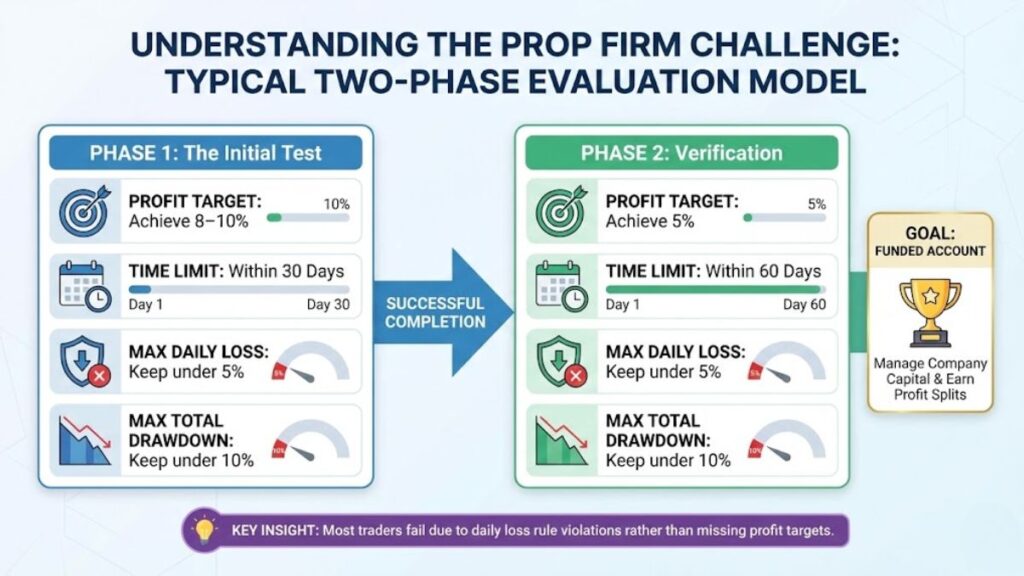
Most forex traders still start with a two-phase CFD evaluation. It is common, widely available, and easier to compare across firms than instant funding or futures-only programs.
Typical versions include:
- Two-phase evaluation: lower entry cost, more rules, profit targets in both phases
- One-phase evaluation: faster path, but often tighter consistency or risk rules
- Instant funding: no challenge, but usually less leverage and more payout restrictions
- Futures prop model: often better for US traders, but not a forex solution if you need spot FX pairs
Which style needs which rules?
Use your trading style as the main filter:
| Trading style | Usually needs | Usually should avoid |
|---|---|---|
| Scalper | Low spreads, fast fills, no consistency trap | Tight daily loss with wide commissions |
| Day trader | Clear daily loss rules, no strange breach language | Hidden inactivity or soft breach reviews |
| Swing trader | Weekend holding, static drawdown, less restrictive news rules | End-of-day flattening or tight trailing drawdown |
| News trader | Clearly stated event rules and restricted windows | Vague "abusive trading" language |
| EA trader | Explicit automation approval, stable platform support | Firms that say EAs are allowed but ban common execution styles |
If you trade slower and hold positions, best prop firm for swing traders is a better comparison set than a generic "best prop firm" list. If you want to skip evaluations, compare best instant funding prop firms separately because the rule logic is different.
How do drawdown and payout rules change your odds?
Drawdown and payout rules decide whether a good strategy can survive long enough to get paid. In practice, they matter more than the headline profit split because they control both your failure rate and your cash flow.
Why is drawdown type so important?
Drawdown type changes your usable risk budget. A static drawdown stays fixed from the starting balance. A trailing drawdown moves upward as your equity hits new highs, which makes it less forgiving for traders who scale into positions or give back part of open profit.
A simple example:
- Static model on $100,000 with 10% max loss: breach line stays at $90,000
- Trailing model on $100,000 that rises with equity: if you push equity to $104,000, your breach line can move up with it
That is why prop firm drawdown rules deserve more attention than discount codes. If you trade intraday volatility, also review max trailing drawdown in prop firms before paying for a challenge.
Which payout rules usually hurt traders after they pass?
The biggest payout traps are not always obvious on the sales page. Look for:
- Minimum trading days before first payout
- Consistency rule, such as one day not exceeding 30% to 40% of total profit
- Buffer rule after payout
- Restricted strategies near major news
- Manual payout review language that is too broad
- Delayed "reward split upgrades" that only start after several payouts
The CFTC says roughly two out of three retail forex accounts lose money in most quarters, a useful reminder that the base market is already hard before firm rules even apply (CFTC). A prop firm with tight rules makes that harder, not easier.
How can you measure challenge difficulty instead of guessing?
You can measure challenge difficulty by comparing profit target, total drawdown, daily loss, time pressure, and rule friction together. This is more useful than comparing fees alone because it tells you how much room your strategy actually has.
Most competing guides stop at "check the drawdown." That is too basic. Score firms using three decision ratios instead.
1. Challenge Pressure Ratio
Formula: Phase 1 profit target / max total drawdown
- 8% target with 10% max loss = 0.80
- 10% target with 8% max loss = 1.25
- 10% target with 6% max loss = 1.67
Lower is usually better. It means you need less return for each unit of allowed loss.
2. Daily Constraint Ratio
Formula: max daily loss / max total drawdown
- 5% daily on 10% total = 0.50
- 3% daily on 8% total = 0.375
Lower can look safer on paper, but it often leaves less room for normal variance. That hurts active forex traders.
3. Rule Friction Score
Give one point for each extra condition: minimum trading days, consistency rule, news restriction, weekend holding restriction, EA restriction, payout delay condition.
A firm with a decent price but a high friction score can be harder than a more expensive challenge with cleaner rules. Traders do not fail only because they trade badly. They often fail because the rule geometry does not match their strategy.
What platform and jurisdiction checks matter in 2026?
In 2026, platform access, broker relationships, and country restrictions matter more than they did a few years ago. A good firm today also needs operational stability, not just fair-looking challenge terms.
Why should platform access be part of the decision?
Platform access is no longer a minor detail. Finance Magnates reported that the 2024 MetaTrader disruption forced many prop firms to cut US clients or move to alternative platforms, and by late 2025 some large brands were only returning through different structures or broker partnerships (Finance Magnates). Platform availability can change faster than a firm's marketing page.
Check:
- MT4, MT5, cTrader, DXtrade, Match-Trader, TradeLocker
- Whether your platform is available in your country
- Whether EAs, trade copiers, or scripts are allowed on that platform
- Whether the firm has recently migrated platforms
If platform choice is core to your strategy, compare platform-specific pages such as best cTrader prop firms, best Match-Trader prop firms, best TradeLocker prop firms, best DXtrade prop firms, or best prop firm with MetaTrader 5.
Why does firm structure matter if you only want payouts?
Firm structure matters because payout reliability depends on operations, not branding. FM Intelligence estimated that 80 to 100 prop firms ceased operations between January 2024 and Q1 2026. The same dataset showed tracked crypto payouts from the top ten firms rising from $55.3 million in Q1 2025 to $115.1 million in Q1 2026, though Finance Magnates noted that growth flattened after December 2025 and average payout size actually fell, a sign more traders are hitting first payouts at smaller amounts (Finance Magnates).
The surviving firms are also restructuring. Between May 2025 and March 2026, five prop firms or their founders added regulated brokerage entities to their corporate structure. FTMO closed a $250 million acquisition of OANDA in December 2025. FundedNext launched its own brokerage, FNmarkets, under a Comoros licence in May 2025. The5ers' founders took a minority stake in CySEC-licensed TSG Brokers. That shift toward regulated brokerage backing is a trust signal a firm cannot fake on its own marketing page.
Check these operational signals:
- Clear company entity and jurisdiction
- Stable rules archive or changelog
- Recent payout proof from multiple months, not one viral screenshot
- Support response quality during breach or payout questions
- Restricted country list that matches the actual checkout flow
For legitimacy checks, how to tell if a prop firm is legitimate should sit in your research stack before any purchase.
What red flags mean you should walk away?
Walk away when a firm is vague about rules, changes terms without warning, hides its entity details, or sells a dream that the math does not support. A flashy discount never cancels out operational risk.
These are the clearest warning signs:
- No clear company entity, address, or jurisdiction
- Rulebook language that allows broad "risk team discretion"
- Payout proof that is old, repetitive, or only posted by the firm itself
- Country restrictions that appear only after checkout
- Constant rebrands, platform swaps, or emergency announcements
- Profit splits that sound huge but only unlock after hard-to-reach milestones
- Terms that punish normal trading variance but are framed as "consistency"
- Marketing that makes prop trading sound easy
The CFTC also warns traders to be skeptical of claims about easy profits, bots, and low-risk forex income, and says to research any company asking you to open a trading account or buy trading software (CFTC).
How should you score and compare prop firms side by side?
Compare prop firms with a simple weighted scorecard that balances rules, payout reality, platform fit, and firm stability. This keeps you from overpaying for a challenge that looks cheap but is hard to survive.
| Category | Weight | What to check |
|---|---|---|
| Rule compatibility | 30% | Drawdown type, daily loss, news, weekends, EAs |
| Challenge difficulty | 20% | Pressure ratio, time limits, friction score |
| Payout quality | 20% | Frequency, proof, thresholds, review process |
| Platform fit | 15% | MT5, cTrader, DXtrade, execution tools |
| Operational trust | 15% | Entity clarity, country access, recent stability |
Score each firm from 1 to 5 in every category.
A quick example
If you are a swing forex trader: static drawdown scores higher than trailing, weekend holding matters more than tight spreads, payout consistency matters more than a 95% split headline, and platform matters if you need MT5 or cTrader for your workflow.
If you are a scalper: low-cost execution matters more, consistency rules are more dangerous, news restrictions matter less if you avoid event spikes, and platform stability matters more than scaling dreams.
This is where your own prop firm account metrics become useful. If your personal max drawdown, average hold time, and win-rate profile do not fit the rulebook, the "best prop firm" for someone else is not the best one for you.
FAQs
What is the best forex prop firm in 2026?
The best forex prop firm in 2026 is the one whose rules match your trading style, payout process, and country access. For most traders, rule fit and payout reliability matter more than headline account size or discount size.
Should you test a prop firm with a free trial before paying for a challenge?
Yes. Run your real strategy on a demo or free trial for at least five trading days first. This checks execution quality and spread behavior at your actual trading hours, which the sales page will not show you.
Is instant funding better than a challenge account?
Instant funding is faster, but it often comes with tighter restrictions, lower leverage, or more payout conditions. It usually suits traders who already know their risk profile and want less evaluation friction.
Are simulated funded accounts normal in prop trading?
Yes. Many retail prop firms use simulated environments and manage risk separately at the firm level. That is common in this market, which makes payout reliability and firm stability more important.
Should beginners buy the cheapest prop challenge?
Usually no. Cheap challenges can hide harder rules, trailing drawdown, or payout friction. A slightly more expensive challenge with better rule geometry is often the better deal. See cheapest prop firms in 2026 for how price and rule difficulty actually compare across the ten lowest-cost firms.
What is the biggest mistake traders make when choosing a prop firm?
The biggest mistake is choosing from marketing claims instead of rule compatibility. A bad match between your strategy and the rulebook will usually fail before pricing ever matters.
Ready to compare firms against your own rules?
The best forex prop firm is the one you can survive, repeat, and get paid from without changing your strategy into something unnatural. Start with drawdown type, challenge pressure, payout rules, and operational stability.
Compare Prop Firms