


What Is Forex Prop Trading in 2026?
Forex prop trading means you trade currency pairs using a prop firm’s simulated account under strict risk rules. You are not depositing $10,000 or $100,000 of your own money like a broker account. Instead, you pay a fee to take an evaluation, follow the rules, and then earn a performance split if you qualify.
The most important mindset shift is this: the real account size is not the headline balance. The real “capital” is your allowed drawdown and daily loss limit. That is the budget you can spend on mistakes. If you treat a $100,000 prop account like you actually have $100,000 to risk, you will usually fail fast.
Prop Firm vs Forex Broker (Why Traders Choose Props Anyway)

If you can trade with a broker, why use a prop firm? This debate shows up everywhere for a reason. Prop firms have stricter rules, but they can offer a faster way to access a larger risk budget without depositing a large amount of personal capital.
Here are the honest reasons people choose forex prop firms:
- They do not want to risk their own savings while learning
- They want the discipline that comes from hard loss limits
- They want access to higher notional exposure than a small personal account can comfortably support
Here are the honest reasons people avoid forex prop firms:
- Many traders fail challenges repeatedly and burn fees
- The rules can force unnatural trading behavior if your strategy is not rule-compatible
- Some firms are more marketing than substance
A mature approach is simple. Use a prop firm if your strategy and psychology naturally fit strict drawdown rules. Use a broker account if you need full flexibility and you are willing to compound slowly.
For the rest of this guide, we will focus on the prop firm route and how to start the right way.
How to Choose a Forex Prop Firm in 2026 (What Actually Matters)
Most traders choose a forex prop firm based on discounts, payout percentages, or social media hype. That is usually a mistake. What matters is how the firm’s rules interact with your trading behavior.
Before looking at brand names, you should understand five rule categories that directly affect whether you survive an evaluation.
Drawdown structure
This is the most important rule. Some firms use balance-based drawdown, others use trailing drawdown, and some lock the drawdown after certain milestones. A trailing drawdown punishes aggressive early profits and oversized trades. Balance-based drawdown is more forgiving for steady traders.
Daily loss limits
Daily loss rules are what usually end challenges early. If your strategy experiences clustered losses or requires multiple attempts per session, tight daily limits can suffocate it.
Consistency rules
Some firms limit how much profit you can make in one day. This directly discourages “one big win” behavior and forces smooth equity curves. Traders who rely on occasional large days usually struggle here.
News and holding restrictions
If your strategy trades during high-impact news, holds overnight, or swings positions, you must verify that the firm allows it. Many traders fail simply because they ignore these details.
Time pressure
Time limits increase psychological pressure. Firms with no time limit allow patience and selective trading. This matters more than most traders realize.
Once you understand these elements, comparing firms becomes much easier.
Forex Prop Firm Comparison: Alpha Capital Group vs City Traders Imperium vs Funding Pips
Below is a rule-focused comparison, not a promotional one. This is designed to help traders decide which firm fits their execution style and psychology.
| Feature | Alpha Capital Group | City Traders Imperium | Funding Pips |
| Evaluation Time Limit | None | None | Varies by model |
| Drawdown Type | Trailing with fixed limits | Balance-based | Trailing or fixed depending on plan |
| Daily Loss Limit | 5% | 5% to 6% | 3% to 5% |
| Overall Drawdown | 10% | 10% | 6% to 10% |
| Consistency Rules | No strict daily profit cap | No consistency rule | Required on some models |
| News Trading | Allowed | Allowed | Restricted on some plans |
| Weekend Holding | Allowed | Allowed | Plan dependent |
| Leverage | Up to 1:100 | 1:30 | Up to 1:100 |
| Best Fit Trader Type | Patient traders who want no time pressure | Traders who value stability and balance-based DD | Traders comfortable with stricter structure |
How to interpret this table
- Alpha Capital Group fits traders who want flexibility, no time pressure, and the ability to trade calmly without rushing profit targets.
- City Traders Imperium fits traders who value long-term stability, balance-based drawdown, and fewer behavioral traps.
- Funding Pips fits traders who are comfortable adapting to stricter rules and different models, especially those who can manage consistency requirements well.
There is no “best” firm. There is only a best match between rules and behavior.
Why Most Traders Fail Forex Prop Firm Challenges
Most traders do not fail because forex is impossible or because prop firms are scams. They fail because their behavior does not survive strict risk constraints.
The most common mistake is misunderstanding what they are actually trading. A $100,000 prop account with a 10% drawdown is not a $100,000 account. It is a $10,000 risk budget with rules attached. When traders size positions as if they have unlimited retries, failure becomes inevitable.
Another major reason is impatience. Many traders try to pass challenges as fast as possible. This leads to overtrading, forcing setups, and increasing risk after losses. One emotional session often erases weeks of disciplined trading.
Prop firms are designed to expose weak discipline quickly. They punish revenge trading, oversized positions, and inconsistency. Traders who treat evaluations like a sprint usually fail. Traders who treat them like a long-term process give themselves a chance.
How to Size Risk Correctly in a Forex Prop Firm Account
Risk sizing is the most important technical skill in prop firm trading. If this is wrong, nothing else matters.
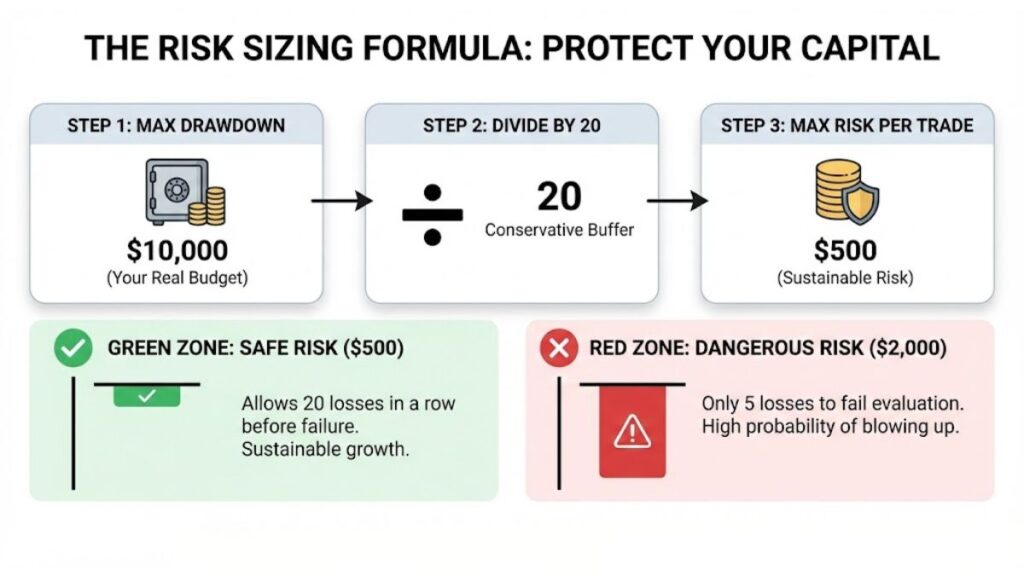
The safest approach is to base risk on the maximum drawdown, not the account balance.
A simple framework that works well:
- Take your maximum drawdown
- Divide it by 20
- That number is your maximum risk per trade
Example:
If your max drawdown is $10,000, your per-trade risk should be around $500 or less. This allows room for normal losing streaks without violating rules.
Most traders fail because they risk too much per trade, not because their strategy is bad. Even a system with a solid win rate will experience losing streaks. Prop firm rules do not forgive oversized losses.
Another important rule is daily protection. If you lose two to three trades in a row, stop trading for the day. Protecting your account is more important than chasing one more setup.
Risk control is what turns a trading strategy into a prop firm strategy.
A Simple Forex Trading Plan That Fits Prop Firm Rules
Most trading plans fail in prop firms because they are built for freedom, not constraints. A prop-friendly plan is not complex. It is narrow, boring, and repeatable.
A good starting structure has four fixed components:
- one or two currency pairs only
- one setup type
- fixed risk per trade
- clear stop conditions for the day
This removes decision fatigue and reduces emotional mistakes.
Your plan should define when you are allowed to trade, not just how. If the setup is not present, you do nothing. Prop firms reward inactivity when conditions are poor.
Setup selection matters more than indicators
Choose a setup that does not require wide stops or extended holding time. Most prop-friendly forex strategies are:
- trend continuation
- pullback continuation
- range fade near clear levels
Avoid strategies that rely on catching full reversals or holding through major news unless the firm explicitly allows it.
Your setup should have:
- a clear invalidation point
- a realistic target that does not require perfect timing
- a risk profile that survives multiple losses in a row
Trade management inside a prop firm
Once in a trade, simplicity wins.
- Stops go where the setup is invalid
- Targets are predefined
- No moving stops out of fear
- No adding to losing trades
If you hit your daily loss threshold or your emotional state changes, the day is over. Protecting the account is part of the plan.
When to Trade and When Not to Trade in a Prop Firm Environment
Timing is one of the most underrated factors in passing prop firm challenges. Not all sessions offer the same quality, even if the setup looks similar on the chart.
Most retail forex traders perform best during high-liquidity sessions, especially:
- London session
- London and New York overlap
These periods tend to offer cleaner movement, tighter spreads, and better follow-through.
Why trading less often helps pass challenges
Overtrading is the silent killer in prop firms. The more trades you take, the more chances you have to make a rule-breaking mistake.
Many successful prop traders limit themselves to:
- one session per day
- one or two high-quality trades
- a hard stop after consecutive losses
This approach reduces drawdown volatility and keeps equity curves smooth.
When you should not trade at all
Do not trade when:
- spreads are wide or unstable
- price is stuck in low volatility ranges
- major news is approaching and your firm restricts it
- you feel the urge to “make something happen”
Not trading is a valid decision. In prop firms, survival comes before opportunity.
Psychology in Forex Prop Trading (The Real Bottleneck)
Most traders think strategy is the hardest part of prop firm trading. It is not. Psychology is.
Prop firm rules amplify emotional mistakes. Small lapses in discipline that might be survivable in a broker account become terminal in an evaluation. This is why many traders with decent strategies still fail repeatedly.
Revenge trading after losses
The most common psychological failure is revenge trading. One loss feels unfair, so the trader increases size, takes a lower-quality setup, or trades outside their plan.
In a prop firm, this usually leads to a daily loss limit breach. The account is gone before the trader even realizes what happened.
Losses must be treated as normal operating costs. If your strategy cannot tolerate a few losses in a row, it is not ready for prop firm rules.
Overconfidence after wins
Winning streaks can be just as dangerous. Traders start to feel invincible and loosen rules. They trade more pairs, more sessions, or increase size without adjusting risk.
This behavior often leads to one oversized loss that wipes out several days of steady progress. Prop firms reward consistency, not momentum trading of emotions.
One rule that saves most traders
If conditions are not there, stop trading.
This applies to both market conditions and mental state. If price action is messy, spreads are wide, or you feel frustrated or impatient, walking away is a valid decision.
In prop trading, protecting the account is a skill.
From Prop Firm to Broker Account (Or Scaling the Right Way)
Many traders ask whether prop firms are a long-term solution or just a stepping stone. The answer depends on how you use them.
Using prop firms as a training and capital bridge
For traders without large starting capital, prop firms can serve as a structured environment to:
- build discipline
- prove consistency
- generate payouts without risking savings
Some traders regularly withdraw profits and move them into a personal broker account. This slowly builds independent capital while keeping risk controlled.
When to consider switching to a broker account
A broker account may make more sense when:
- your strategy requires more flexibility
- prop firm rules limit your edge
- you want full control over risk and compounding
Traders who are consistently profitable in prop firms often find broker trading easier, not harder, because the discipline is already built.
Scaling responsibly inside prop firms
If you stay with prop firms long term, scaling should be gradual. Increasing account size or running multiple accounts only makes sense if:
- drawdowns stay controlled
- rule compliance is consistent
- psychology remains stable
Scaling too fast is one of the fastest ways to lose progress.
Conclusion: How to Start Forex Trading With a Prop Firm the Right Way
Starting forex trading with a prop firm in 2026 is not about finding shortcuts or passing challenges as fast as possible. It is about learning to trade inside constraints and proving that you can manage risk consistently.
Prop firms are not designed to reward aggression. They reward patience, discipline, and repeatable execution. Traders who treat evaluations like a sprint usually fail. Traders who treat them like a long-term process give themselves a real chance.
The most important takeaway is simple. Your success is determined less by your strategy and more by how well your behavior fits the rules. When risk is sized correctly, trades are taken selectively, and emotions are controlled, the prop firm model can work as intended.
Whether you choose to stay with prop firms long term or use them as a stepping stone toward trading your own capital, the foundation is the same. Respect drawdowns, trade only when conditions are favorable, and protect your account first.
That is how traders last.
FAQ
Is forex prop trading legit in 2026?
Forex prop trading is legitimate, but it is not easy money. Prop firms make money from evaluation fees and from traders who can follow strict rules consistently over time. The model works best for traders who already have structure, discipline, and risk control. It does not work well for traders looking to gamble or get rich quickly. When approached as a business arrangement with clear constraints, forex prop trading can be a valid way to trade without risking large personal capital.
Why do most traders fail forex prop firm challenges?
Most traders fail challenges because of behavior, not strategy. Common reasons include overtrading, risking too much per trade, revenge trading after losses, and ignoring daily loss limits. Many traders also rush to pass instead of letting consistency do the work. One emotional trading day is often enough to fail an otherwise solid evaluation. Prop firm challenges reward discipline, not urgency.
Is it better to start forex trading with a prop firm or a broker?
It depends on the trader. Prop firms are often better for traders who want structure, strict risk limits, and access to a larger risk budget without depositing large capital. Broker accounts are better for traders who want full flexibility, no external rules, and long-term compounding. The best option is the one that fits your psychology, strategy, and capital situation.
How much should I risk per trade in a forex prop firm?
A common and safer approach is to base risk on the maximum drawdown, not the account balance. Many traders use a simple rule of risking no more than one twentieth of the total drawdown per trade. This allows the strategy to survive normal losing streaks without breaking prop firm rules.
Are forex prop firm challenges designed to make traders fail?
Prop firm challenges are designed to filter out traders who cannot control risk and emotions. They are difficult by design, but not impossible. Traders who trade selectively, risk conservatively, and respect the rules can pass. Most failures come from impatience, oversized risk, and repeated rule-breaking rather than from the challenge structure itself.
Can I make a long-term career trading forex with prop firms?
Some traders use prop firms long term, while others use them as a stepping stone to build capital for a personal broker account. Long-term success depends on consistent payouts, strict rule compliance, and controlled scaling. Prop firms are best treated as a business relationship, not a guarantee of income.